
Last updated: November 17, 2026
Medically reviewed by: Dr. Emily Carter, MD , Board-Certified Family Medicine Physician
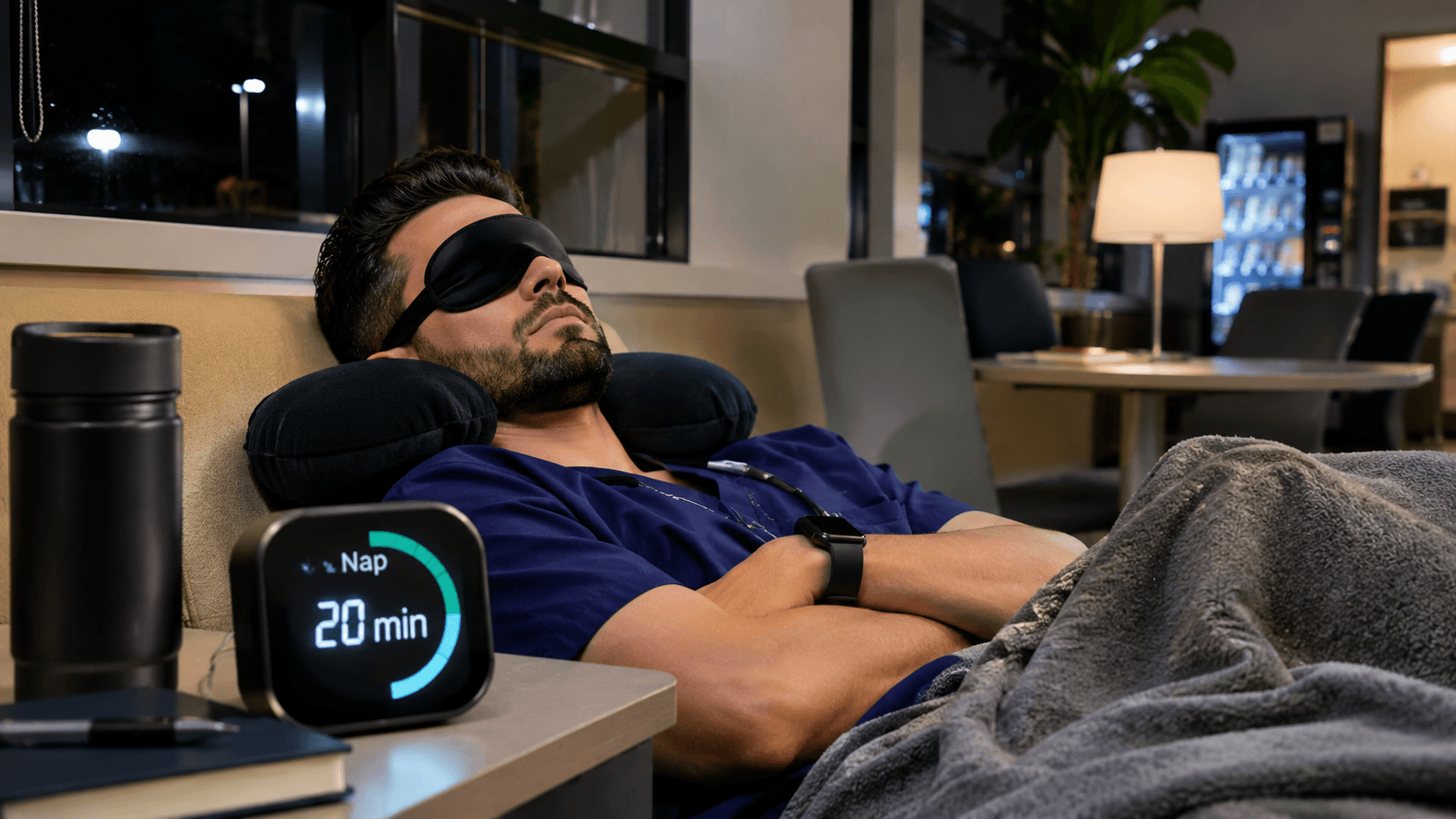
You finally catch a break four hours into your overnight shift. There is a quiet breakroom down the hall, and you have just enough time to shut your eyes for a few minutes.
You set an alarm on your phone, lean back in your chair, and drop right off.
Twenty minutes later, your alarm goes off. Instead of feeling sharp and ready to go, you wake up completely disoriented. Your head feels like it is full of wet cement, your mouth is dry, and it takes two full minutes just to remember what day it is.
So, was taking that nap a mistake?
Not necessarily. Naps can be a lifesaver when you work nights, but how you feel afterward comes down to timing, duration, and how badly sleep-deprived you already were before you closed your eyes.
When you start looking into napping strategies for shift workers, the first reality check is that there is no magic stopwatch number that works for everyone. A quick 15-minute snooze fits nicely into a mid-shift break, while a longer stretch before you clock in banks extra rest for a long night ahead. Both have their place, though neither one will ever replace a solid block of main sleep.
The Nap-Length Sweet Spot — Why 20 Minutes vs. 90 Minutes Matters
You have probably heard the standard sleep advice: keep your nap to 20 minutes so you stay in light sleep, or stretch it to 90 minutes so you complete a full sleep cycle.
There is solid science behind those numbers, but human brains rarely follow a strict stopwatch.
As soon as you drift off, your brain cycles through lighter stages of sleep, drops into deep slow-wave sleep, and eventually enters rapid eye movement (REM) sleep. The catch is that a single sleep cycle doesn’t always last exactly 90 minutes. Cycle lengths vary from person to person—and even shift from one night to the next. Setting a timer for 90 minutes improves your odds of waking up smoothly, but it is never a guarantee.
What Happens During a Short Nap?
A quick 10- to 20-minute nap takes the edge off drowsiness without eating up your whole afternoon or evening. If you are reasonably well-rested, you usually stay in lighter sleep stages and wake up feeling noticeably sharper.
However, if you have been running on four hours of sleep all week, your exhausted brain can plunge straight into deep sleep within ten minutes—leaving you groggy even after a tiny power nap.
What About a Longer Nap?
When you have a free afternoon or evening before an overnight shift, a 90-minute or two-hour nap helps relieve built-up sleep pressure before you even walk through the workplace doors. You get real, restorative rest, provided you give yourself enough buffer time to shake off the cobwebs before driving to work.
| Nap Duration | Potential Benefits | Limitations | Suitable Situations |
| 10–15 minutes | Gives a quick boost in alertness without eating into your schedule. | You might spend the whole time trying to fall asleep; mild grogginess is still possible. | Short, approved workplace breaks. |
| 15–30 minutes | Takes the heavy edge off drowsiness for a couple of hours. | Waking up groggy (sleep inertia) can still happen, especially if you are sleep-deprived. | Planned breaks where you have a few minutes to wake up afterward. |
| 30–60 minutes | Delivers deeper, more restorative rest than a quick power nap. | High chance of waking up right in the middle of deep sleep feeling sluggish. | Longer rest windows when you don’t have to jump straight into risky tasks. |
| Around 90 minutes | Gives your brain room to move through lighter, deep, and REM stages. | Still doesn’t guarantee a clean wake-up or a textbook sleep cycle. | Longer pre-shift rest blocks at home before work. |
| 2–3 hours | Cuts down heavy sleep pressure ahead of a grueling overnight shift. | Eats up a big chunk of your day and can make it harder to sleep after work. | Planned recovery before a 12-hour night shift or schedule flip. |
Treat these windows as rough guidelines rather than rigid rules. How fast you fall asleep and how tired you are going in will always change the outcome.
Pre-Shift Naps vs. Mid-Shift Naps — Different Purposes
Napping at home before work and catching a quick snooze on a break serve two totally different goals. One builds a buffer before you get tired; the other helps you survive once fatigue has already set in.
Pre-Shift Naps
Imagine your shift starts at 11:00 p.m., and you have been awake since 9:00 a.m. By the time you clock out at 7:00 a.m. the next morning, you will have been awake for 22 straight hours—roughly the cognitive equivalent of being legally drunk.
Sleeping in the late afternoon or early evening prevents that crash. Sleep researchers call this a prophylactic nap—essentially banking sleep before you know you are going to miss it. Research from the National Institute for Occupational Safety and Health (NIOSH) shows that longer naps taken before a night shift reliably keep alertness higher during those brutal early-morning hours.
Just remember that a pre-shift nap is meant to supplement your main daytime sleep, not replace it. If you only got four hours of sleep after your last shift, an hour-long evening nap will help, but you will still feel the deficit. (For help blocking out your primary rest hours, see our Night Shift Sleep Schedule guide.)
Mid-Shift Naps
Grabbing 20 minutes of shut-eye on the clock can rescue a rough night, provided your employer allows it and proper safety coverage is in place. Many hospitals, fire stations, and emergency dispatch centers build scheduled rest breaks into 12-hour overnight shifts.
Never close your eyes while you are responsible for monitoring patients, watching equipment, or sitting behind the wheel. Always arrange coverage with a coworker or supervisor first, and make sure you have a quiet, safe spot to rest where an alarm will actually wake you up.
How to Avoid Sleep Inertia
We have all been there: you wake up from a nap feeling ten times worse than you did before you lay down. You know where you are, yet your brain feels like it is moving through quicksand. Simple decisions feel overwhelming, and your reaction times are shot.
That heavy fog is called sleep inertia. It is a normal, temporary state where parts of your brain are still booting back up after sleep.
Why Does Sleep Inertia Happen?
Sleep inertia hits hardest when your alarm goes off right in the middle of deep slow-wave sleep. It also strikes with a vengeance when you are already carrying heavy sleep debt or when you try to wake up during your body’s natural circadian low point—typically between 2:00 a.m. and 6:00 a.m. While the fog often clears in 10 to 15 minutes, severe sleep inertia can linger for 30 minutes or longer.
Give Yourself Time After Waking
If your job involves driving a truck, operating machinery, or administering medications, never jump straight from a cot into action the second your alarm rings. NIOSH specifically warns shift workers to give sleep inertia time to wear off before taking on safety-critical duties. Plan on at least 15 to 20 minutes of buffer time to sit up, stretch, and let your brain fully come online.
Can Light or Movement Help?
Stepping out of a dark breakroom into bright light, splashing cold water on your face, or taking a brisk walk down the hallway helps signal to your brain that it is time to wake up. Those tricks speed up the transition, though they won’t instantly erase deep grogginess. If your head still feels cloudy, take a few more minutes before touching hazardous equipment. (For more ways to stay sharp on the clock, read our Night Shift Fatigue guide.)
A Sample Nap Schedule for a Typical Night Shift
If you work a standard 12-hour overnight shift from 7:00 p.m. to 7:00 a.m., your schedule has to balance commuting, meals, family life, and sleep. Here is one realistic way to fit naps around your main rest period:
| Time | Example Routine |
| 8:00 a.m. – 3:30 p.m. | Main daytime sleep period (7.5 hours in bed). |
| 4:30 p.m. – 5:00 p.m. | Optional 30-minute pre-shift nap if your daytime sleep got cut short. |
| 7:00 p.m. | Clock in and start your shift. |
| 1:00 a.m. – 1:20 a.m. | Optional 20-minute power nap during an approved, covered meal break. |
| 1:20 a.m. – 1:40 a.m. | Wake-up buffer (drink water, walk around) before returning to key duties. |
| 7:00 a.m. | Clock out and check whether you are alert enough to drive home safely. |
You don’t need to follow this down to the minute. If you slept like a rock from 8:00 a.m. to 4:00 p.m., skip the afternoon nap. If your workplace prohibits sleeping on breaks, lean on a slightly longer pre-shift nap at home instead. (For tips on blocking out morning light and street noise, see How to Sleep During the Day.)
Writer’s Take — Start With the Sleep You’re Missing
It is easy to get obsessed with optimizing nap math—debating whether 18 minutes is better than 22 minutes, or setting timers down to the second.
Truthfully, none of that fine-tuning matters if you are only sleeping four hours a day.
Before you start scheduling mid-shift power naps, take an honest look at your main daytime sleep block. Are you staying up until 11:00 a.m. doing laundry and running errands? Is sunlight pouring around your blinds? Is your phone buzzing on the nightstand every twenty minutes? Fix your main sleep first. Treat naps as a helpful bonus for tough nights, not a duct-tape fix for chronic sleep deprivation.
What If You Can’t Fall Asleep During a Short Break?
Plenty of people lie down for a 20-minute break and spend the entire time staring at the ceiling, listening to footsteps in the hallway, or stressing about sleeping through their alarm.
That is completely normal—especially when you are trying to sleep in a breakroom chair under fluorescent lights.
Whatever you do, don’t force it. Getting frustrated only spikes your heart rate and makes rest impossible. Instead, put your phone on Do Not Disturb, lean back, close your eyes, and treat it as 20 minutes of quiet mental downtime. Resting with your eyes closed won’t give you the same restorative punch as actual sleep, so don’t count it toward your daily sleep total, but it still gives your eyes and brain a breather from a hectic shift.
Do Caffeine Naps Really Work?
You may have heard night-shifters swear by the caffeine nap (sometimes called a “nappuccino”). The routine is simple: chug a cup of coffee right before lying down for a 20-minute nap. Because caffeine takes roughly 20 to 30 minutes to absorb into your bloodstream and reach your brain, it kicks in right as your alarm goes off—clearing away sleep-inducing chemicals while giving you a fresh wave of alertness.
Some sleep studies show that pairing caffeine with a short nap beats either one on its own for short-term focus. Still, it isn’t magic. If you are severely sleep-deprived, you will still wake up groggy. Worse, if you take a caffeine nap at 4:00 a.m. and clock out at 7:00 a.m., that caffeine will still be buzzing in your system when you try to go to bed at home. (Read our Caffeine Timing guide before making coffee part of your nap strategy.)
Why Naps Can’t Replace Your Main Sleep
A well-timed 20-minute nap can pull you out of a 3:00 a.m. slump, yet it only scratches the surface of what your body actually needs to recover.
Most adults need seven to nine hours of solid sleep every 24 hours to keep their immune system, memory, and reaction times running properly. If you routinely get four or five hours of broken sleep during the day, stitching together two short naps won’t stop sleep debt from piling up. Over weeks and months, that chronic deficit leads to burnout, careless mistakes on the job, and dangerous microsleeps on the drive home.
The goal of working nights isn’t learning how to survive on scraps of rest—it is protecting enough total sleep so you stay healthy and safe. If you block out plenty of time to sleep and still feel completely wiped out every shift, talk to a doctor to rule out underlying issues like shift work disorder or sleep apnea.
What Research Says About Planned Naps
Occupational safety researchers have studied workplace napping for decades, and the findings are clear: strategic rest works when it is managed properly.
The National Institute for Occupational Safety and Health (NIOSH) highlights planned naps as an effective tool for cutting down overnight fatigue—while reminding workers and employers to account for post-nap sleep inertia before resuming high-risk tasks.
Aviation researchers found similar results. In a well-known 1994 NASA study led by Dr. Mark Rosekind, long-haul pilots given a planned 40-minute cockpit rest break slept for an average of 26 minutes. Afterward, those pilots showed significantly faster reaction times and fewer lapses in attention during the final stretch of their flights compared to pilots who stayed awake the whole time. While a hospital floor or warehouse isn’t an airplane cockpit, the core takeaway holds up: brief, structured rest keeps tired brains sharper.
Frequently Asked Questions
Is a 20-Minute Nap Really Enough?
A 20-minute nap is plenty to sharpen your focus and take the edge off drowsiness for a couple of hours. Just remember that how refreshed you feel depends heavily on how sleep-deprived you were beforehand and whether you wake up out of deep sleep.
What If I Can’t Fall Asleep in 20 Minutes?
Don’t stress about it. Keep your eyes closed, put your phone away, and let your body rest quietly for the remainder of your break. You won’t get the full benefits of sleep, but quiet downtime still lowers stress and rests your eyes.
Do Naps Ruin Nighttime Sleep?
Yes, they can—especially if you sleep longer than 30 to 45 minutes or nap too close to your main bedtime. Keeping mid-shift naps brief and finishing pre-shift naps several hours before your main sleep window helps protect your primary rest.
Are Workplace Nap Pods Worth Using if Available?
If your hospital, warehouse, or office has nap pods, take advantage of them. Blocking out harsh overhead lights and breakroom chatter makes it much easier to fall asleep quickly. That said, a reclining chair in a dark, quiet room with a pair of earplugs works just as well.
Is a 90-Minute Nap Better Than a 20-Minute Nap?
Neither one is universally “better”—they just fit different parts of your day. A 90-minute nap gives you deeper recovery at home before a long shift, while a 20-minute nap fits neatly into a workplace break without ruining your schedule.
Should I Nap Before Every Night Shift?
Not if you already got seven or eight hours of solid sleep during the day. Save pre-shift naps for days when your morning sleep got interrupted, or when you are flipping from a daytime schedule onto your first night shift of the week.
Can I Return to Work Immediately After a Nap?
If you work at a computer desk, maybe. If you drive, operate heavy equipment, or care for patients, give yourself at least 15 to 20 minutes to wake up, drink some water, and make sure any grogginess has cleared before jumping back in.
Can Naps Make Up for Lost Sleep?
Naps are great for managing short-term drowsiness, but they cannot fully erase chronic sleep deprivation. Nothing replaces getting seven to nine hours of quality main sleep each day.
Final Thoughts
Dialing in the right napping strategies for shift workers takes a little experimenting. A quick 20-minute snooze might save you during a slow 2:00 a.m. break, while a 90-minute nap on the couch before work can carry you through a tough 12-hour shift.
Don’t get discouraged if a nap occasionally leaves you feeling groggy—that is just your brain needing a few minutes to boot back up. Give yourself a short buffer after your alarm goes off, never rush straight into safety-sensitive work while half-asleep, and always treat your main daytime sleep as your top priority.
Sources
- Centers for Disease Control and Prevention (CDC / NIOSH) — Napping, an Important Fatigue Countermeasure: https://www.cdc.gov/niosh/work-hour-training-for-nurses/longhours/mod7/01.html
- CDC / NIOSH — Nap Duration: https://www.cdc.gov/niosh/work-hour-training-for-nurses/longhours/mod7/04.html
- CDC / NIOSH — Sleep Inertia: https://www.cdc.gov/niosh/work-hour-training-for-nurses/longhours/mod7/03.html
- CDC / NIOSH — Planned Naps at Work: https://www.cdc.gov/niosh/work-hour-training-for-nurses/longhours/mod7/06.html
- Rosekind, M. R., et al. (1994) — Effects of Planned Cockpit Rest on Crew Performance and Alertness in Long-Haul Operations (NASA Technical Memorandum 108839): https://ntrs.nasa.gov/citations/19950006379
- CDC / NIOSH — Managing Fatigue During Times of Crisis: https://blogs.cdc.gov/niosh-science-blog/2020/04/02/fatigue-crisis-hcw/
Internal Link Suggestions
- Night Shift Fatigue (or your site’s exact URL slug for the Night Shift Fatigue article)
- Night Shift Sleep Schedule (or your site’s exact URL slug for the Night Shift Sleep Schedule article)
- Caffeine Timing (or your site’s exact URL slug for the Caffeine Timing article)
- How to Sleep During the Day (or your site’s exact URL slug for the How to Sleep During the Day article)
- How to Stay Awake During a Night Shift Naturally (or your site’s exact URL slug for the Staying Awake article)
(Note: Since I don’t have your website’s live domain or exact URL structure, I’ve used clean, standard SEO URL slugs above—just swap in your exact published URLs before hitting publish.)
External Authority Links
- CDC / NIOSH — Work Hours and Fatigue: https://www.cdc.gov/niosh/topics/workschedules/
- NASA — Planned Cockpit Rest Research: https://ntrs.nasa.gov/citations/19950006379
- Sleep Foundation — Shift Work Disorder: https://www.sleepfoundation.org/shift-work-disorder
Editorial note: This article provides general sleep information. Nap timing, recovery periods, and workplace safety decisions should account for individual circumstances and workplace policies. Medical and occupational safety review is recommended before publication.

Daniel Carter is the founder of NightShiftWell. He spent over a decade working night and rotating shifts in logistics and warehouse operations before starting this site to share what actually works — and what doesn’t — for staying healthy on an inverted schedule.
1 thought on “Napping Strategies for Shift Workers: Science-Backed Timing”