Last updated: September 29, 2026
Medically reviewed by: Dr. Emily Carter, MD , Board-Certified Family Medicine Physician
You finished your shift hours ago. You drove home through empty streets while the rest of the world was just waking up. Your body feels heavy, your eyes sting, and your bones ache from standing on hard hospital floors or pacing a warehouse floor all night. You finally crawl into bed, pull the heavy curtains shut, and wait to drift off.
Instead, your mind starts racing.
You stare at the ceiling, tracking the crawling sunlight on your wall. You are exhausted. Your body is begging for rest. Yet your brain refuses to switch off.
How can you be this tired and still not sleep?
What Shift Work Insomnia Actually Is — And How It Differs from Normal Tiredness
Every shift worker knows what it feels like to be tired after a hard week. You work an extra-long stretch, your sleep schedule gets scrambled, and you feel drained for a day or two. That is normal fatigue. It usually fixes itself after a couple of solid nights of rest or a proper weekend catch-up session.
Shift work insomnia is different. It is not just feeling sleepy. It is a persistent disruption in your sleep patterns directly tied to the odd hours you work.
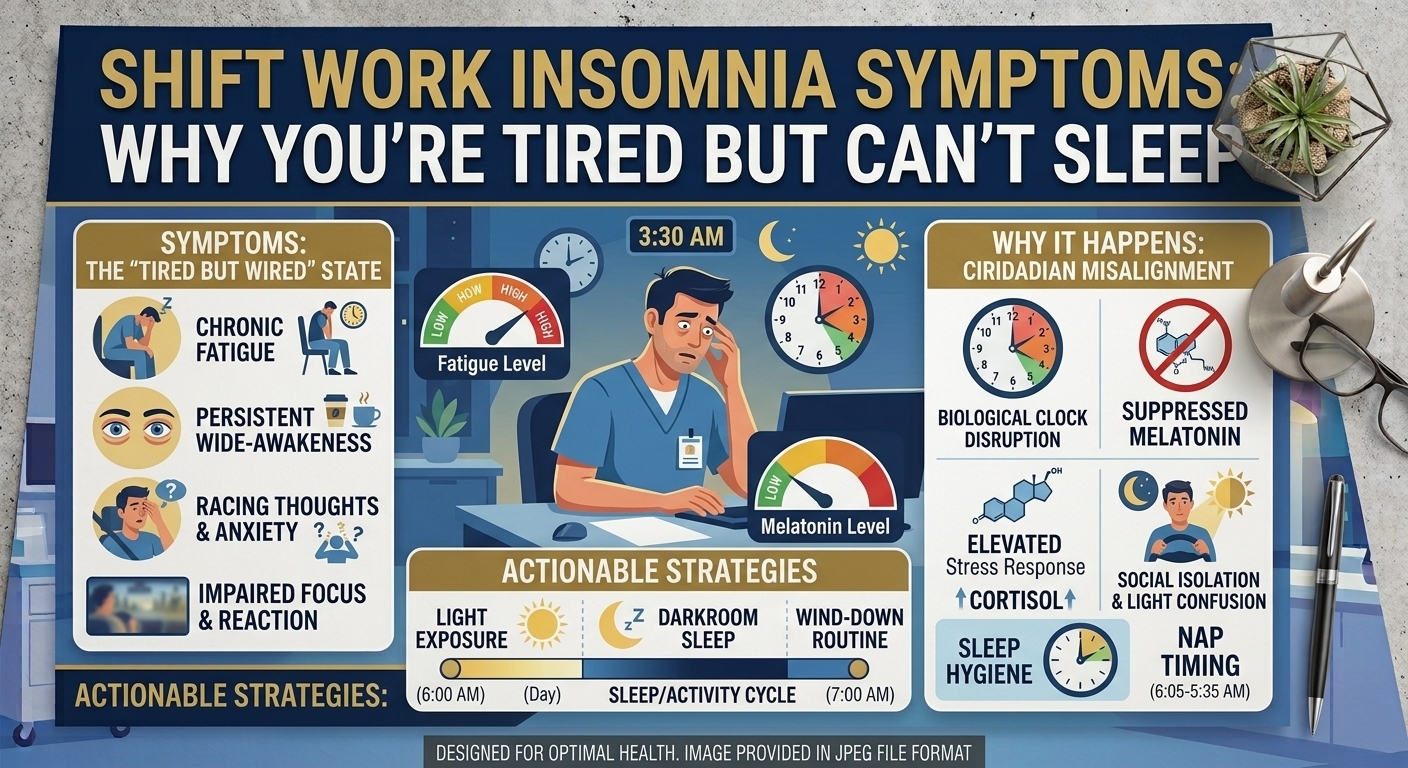
When you work against the clock, your internal body clock—the suprachiasmatic nucleus tucked inside your brain—gets completely confused. According to the American Academy of Sleep Medicine (AASM), your body is biologically programmed to be awake when the sun is up and asleep when it is dark. When your job asks you to flip that cycle upside down, your brain still tries to pump out alertness hormones like cortisol during the day and hold back sleep-inducing melatonin.
This creates a brutal mismatch. You try to sleep when the world is noisy and bright, and you try to stay awake when your biology is screaming at you to shut down.
A single bad night of sleep after a sudden shift change does not mean you have a chronic sleep disorder. But when trouble falling or staying asleep happens week after week, and it starts messing with your daily life, it moves past ordinary tiredness. It crosses into a pattern that health professionals monitor closely.
Common Shift Work Insomnia Symptoms Workers Reported
Shift work insomnia does not look the same for everyone. It shows up in different ways depending on your exact hours, your age, and how long you have worked odd schedules.
The most common signs workers report include:
- Staring at the ceiling for hours: You crawl into bed right when the sun is coming up, but instead of dropping off, your mind races. You watch the clock tick by, hour after hour, completely wired despite being dead on your feet.
- Jolting awake all night long: You manage to drop off, but it is shallow, jumpy rest. You snap awake every forty minutes or an hour, feeling every little creak in the house, never dropping into that heavy, healing sleep your body desperately needs.
- Eyes snapping open way too early: You mapped out your day to get a solid block of rest before an afternoon shift, but your eyes fly wide open hours before your alarm. You try everything to drift back off, but your brain refuses to cooperate.
- Waking up feeling completely wrecked: You managed to log seven hours under the heavy covers during broad daylight, but your alarm goes off and you feel like a truck ran over you. Your limbs feel leaden, and your head pounds with a dull ache.
- Hitting a wall of heavy exhaustion on the job: Around three or four in the morning, a crushing wave of fatigue drags you down. Your eyelids weigh fifty pounds, and you have to fight hard just to stay upright and track what is happening right in front of you.
- Snapping at people over nothing and losing your edge: Your brain feels like it is swimming in cotton wool. You snap at your partner over where the car keys are, forget simple instructions coworkers just gave you, and struggle to keep your thoughts straight.
If you only have a rough night of sleep once in a while after a schedule swap, that is regular life for a shift worker. But if you find yourself tossing and turning day after day, unable to get stable rest no matter how hard you try, it is worth paying attention to.
[How to Sleep During the Day After a Night Shift]
Non-Medication Strategies That Have Research Support
When sleep feels impossible, it is tempting to look for quick fixes. But changing your daily habits and environment can make a measurable difference in how well your body handles odd hours. The research suggests that a variety of effective strategies are able to alleviate the stress of sleep problems during shifts without the need for prescriptions.
1. Light Management on the Commute Home
Light is the single most powerful signal to your brain clock. When you walk out of a night shift into bright morning sunlight, that light hits your eyes and signals your brain to wake up, destroying any chance of deep sleep when you get home.
- Why it helps: Blocking morning light tricks your brain into thinking it is still nighttime, protecting the melatonin you need to fall asleep.
- How to use it realistically: Keep a pair of dark, polarized sunglasses in your car or bag. Put them on the second you walk out the building doors at the end of a night shift. Wear them all the way home, even if it is cloudy.
2. Crafting a True Daytime Cave
Your bedroom environment fights a constant war against daytime realities like lawnmowers, delivery trucks, and bright sunlight leaking through mini-blinds.
- Why it helps: Total darkness stimulates melatonin production, while a cool room matches the body’s natural temperature drop during rest.
- How to use it realistically: Blackout curtains are a good start, but if light still creeps around the edges, tape heavy-duty trash bags or foil over the glass. Turn down your thermostat as low as you comfortably can, and use a white noise machine or a loud fan to drown out daytime neighborhood noise.
3. A Strict Wind-Down Routine
You cannot jump straight from operating machinery, charting patient files, or stocking shelves into deep sleep. Your nervous system is still revved up in “fight or flight” mode.
- Why it helps: A predictable wind-down sequence tells your brain that work is over and safety has arrived.
- How to use it realistically: Give yourself a buffer zone of 30 to 45 minutes before bed. Do not check work emails or scroll through stressful news on your phone. Take a warm shower (which helps drop your core body temperature afterward), change into loose clothes, and read a physical book in dim light.
4. Strategic Caffeine Cutoffs
Caffeine is a shift worker’s best friend during the first half of a shift, but it can turn into an enemy if consumed too close to bedtime.
- Why it helps: Caffeine blocks adenosine, a chemical in your brain that builds up pressure to make you sleepy. Caffeine can stay active in your bloodstream for hours.
- How to use it realistically: Stop consuming all caffeine at least six hours before your planned sleep time. If your shift ends at 7:00 AM and you plan to sleep by 8:00 AM, your last cup of coffee or energy drink should happen around 1:00 or 2:00 AM.
[What to Eat Before, During, and After a Night Shift]
When to See a Doctor
There is a big difference between regular work-related fatigue and a medical sleep disorder that requires professional insight. If your sleep struggles are controlling your life, it is time to loop in a healthcare professional.
Consider talking to your doctor if:
- Your sleep problems have persisted for months despite trying basic sleep hygiene changes.
- The daytime is a time of extreme sleepiness, making it risky for you to return home from your job.
- You find yourself nodding off while operating machinery or performing critical tasks at your office.
- Sleep disturbances are starting to take their effect on your mental health and relationships as well as job productivity.
A critical safety note: If you are so exhausted that you struggle to keep your eyes open while driving, do not drive. Pull over in a safe, well-lit public area and rest, call a rideshare service, or ask a family member or coworker to pick you up. No shift is worth your life or the lives of others on the road.
Only a qualified medical provider can evaluate your full health history, rule out other conditions like sleep apnea or iron deficiency, and provide an accurate diagnosis.
The Writer’s Real Take
When you look at all the research surrounding shift work sleep issues, one single lifestyle change matters more than almost anything else: protecting your main sleep period with an unwavering routine.
It sounds simple, but consistency is the hardest thing for a shift worker to maintain. When you get home from a brutal night shift, it is tempting to run errands, go to appointments, or stay up to hang out with family. But chopping your sleep into two or three-hour chunks destroys your sleep architecture.
If you commit to defending your primary block of daytime sleep—treating it with the same absolute respect that a 9-to-5 worker treats their nighttime bed—your body learns when it is safe to rest. Build your entire day around that sleep block rather than trying to fit sleep into whatever time is left over. It takes discipline, but it is the anchor that holds everything else together.
[How to Reset Your Circadian Rhythm for Shift Work]
Frequently Asked Questions
Is shift work insomnia a real diagnosis?
Yes, persistent sleep disruptions caused by working irregular or night hours are recognized clinical conditions evaluated by sleep medicine specialists. An accurate diagnosis will require an in-depth examination of your logs of sleep, work background, and general health habits by a certified physician.
Does it go away if I quit night shifts?
Many workers’ patterns of sleep begin to change after returning to the normal daytime schedule and normal light-dark cycle. If the disturbance in sleep has been ongoing for long periods, the process can take a long time to get your circadian rhythm completely adjusted.
Can melatonin help?
Melatonin is an organic hormone that regulates the sleep cycle and can be used to assist shift workers to adjust the internal rhythms of their bodies. Since the dosage, timing, and your individual health issues affect you significantly, it is important to consult with a medical specialist prior to consuming supplements.
How is it different from regular insomnia?
In the case of regular insomnia, you may have trouble sleeping regardless of the fact that you are able to sleep during normal evening hours. The insomnia of shift work is due to a conflict between your schedule at work and your biological clock.
Sources
- American Academy of Sleep Medicine (AASM). International Classification of Sleep Disorders (ICSD-3). Circadian rhythm sleep-wake disorders guidelines. AASM Resource Library
- National Institute for Occupational Safety and Health (NIOSH). Shift Work and Long Hours Overview. Centers for Disease Control and Prevention. NIOSH Workplace Safety and Health Topics
- Drake, C. L., et al. (2004). Shift work sleep disorder: prevalence and consequences in a general population sample. Sleep, 27(8), 1453–1462. PubMed Study
- Wickwire, E. M., et al. (2017). Shift Work and Shift Work Sleep Disorder: Clinical and Organizational Perspectives. Chest, 151(5), 1156–1172. PubMed Central

Daniel Carter is the founder of NightShiftWell. He spent over a decade working night and rotating shifts in logistics and warehouse operations before starting this site to share what actually works — and what doesn’t — for staying healthy on an inverted schedule.