Last updated: September 29, 2026
Medically reviewed by: Dr. Emily Carter, MD , Board-Certified Family Medicine Physician
Your alarm goes off at 6:00 PM, and you roll over to check your phone. There’s a group text from your brother asking why you skipped Sunday dinner, alongside a photo of everyone laughing around a crowded table. You sigh, type out a quick apology about sleeping for your night shift, and stare at the ceiling. Figuring out how to have a social life working nights can feel like trying to solve a puzzle where half the pieces belong to a different game.
Why Social Life Is Genuinely Harder on Night Shift
Working unconventional hours changes more than just your sleep cycle. It alters your entire relationship with time. When friends and family are winding down after work, you are just starting your shift. When the rest of the world has Saturday off, you might be sleeping off a grueling week or heading in for a twelve-hour weekend stretch.
This mismatch creates practical roadblocks that go far beyond being simply busy. You miss evening gatherings because you are at work. You miss morning get-togethers because you are dead asleep. Even when you are technically off, your body is often too tired from a rotating shift schedule to enjoy a loud restaurant or a late-night party.
People who work standard hours often struggle to understand this reality. They suggest you “just stay up a little later” or “wake up a bit early,” not realizing that doing so ruins your recovery sleep. Over time, constant scheduling conflicts can make you want to stop trying altogether. That doesn’t make you antisocial. Your clock is simply different from everyone else’s.
Practical Scheduling Tactics That Actually Help
When your free hours don’t match the rest of the world, spontaneity becomes nearly impossible. You cannot rely on running into friends or making last-minute plans. Instead, you have to approach your social life with intention.
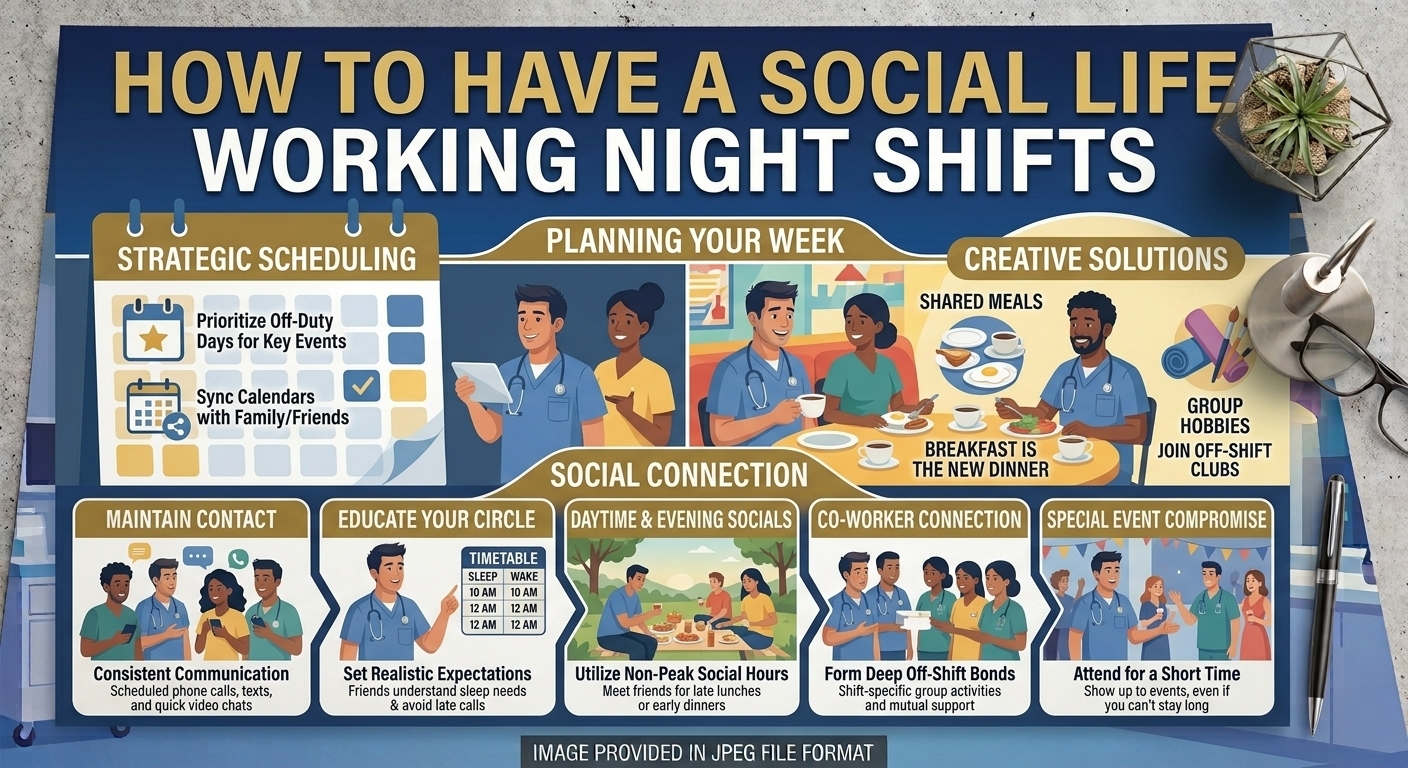
Start by being direct about your availability. Instead of telling people you are busy, give them your actual working and sleeping windows. Say something like, “I work Thursday through Saturday nights, but I’m completely free on Tuesday afternoon.” When people know your real schedule, they can plan around it.
It also helps to flip how you look at social meetings. If dinner or late-night drinks clash with your night shift schedule, look for alternative times. Meet a friend for breakfast right after you wake up at 4:00 PM, which feels like morning to you. Treat these alternative meetups as your version of normal.
Put your social plans into a calendar just like you would a doctor’s appointment or a shift rotation. Planning ahead gives your body time to adjust its sleep schedule. If you know you have a family birthday on a Tuesday, you can manage your rest beforehand so you aren’t completely exhausted when you arrive.
[How to Sleep During the Day After a Night Shift]
Protect your core rest without feeling guilty about it. If you need sleep from 8:00 AM to 3:00 PM, let your loved ones know those hours are off-limits for social visits. Setting clear boundaries ensures you have the physical energy to be genuinely present when you do spend time with others.
Build a Social Circle That Understands Your Schedule
Trying to force all your social interactions into a traditional mold will drain you. One of the best ways to keep a healthy social life is to expand your circle to include people who actually get what it’s like to work odd hours.
This doesn’t mean cutting off your longtime friends who work standard daytime jobs. It simply means adding people to your life who share your reality. That might include coworkers on your shift, other local night workers, or friends who work freelance or night-time hospitality jobs.
When you talk to someone who also works nights, you don’t have to explain why you are sleeping at noon or why a Tuesday morning feels like a Friday night to you. That shared understanding removes a lot of social friction. You can grab breakfast at 7:00 AM after a long shift without feeling like an oddity.
Online communities and local groups for shift workers can also bridge the gap. Finding people who understand the physical and mental rhythm of nocturnal employment helps reduce the isolation that often creeps into night-shift life. When you are wide awake at 3:00 AM while the rest of your neighborhood is fast asleep, scrolling through a forum of fellow night workers or grabbing a quick coffee with a coworker who just finished the same grueling shift can completely change your outlook. It reminds you that you are not the only person living on a reverse clock, and having that shared outlet takes away a lot of the heavy, lonely weight that usually comes with working unconventional hours.
Protect Relationships With People on Normal Schedules
Maintaining bonds with family and friends who work standard daytime hours takes patience from both sides. Your loved ones probably aren’t trying to frustrate you when they invite you to a Saturday noon barbecue; they just forget that your body clock is running backward.
Communication is your best tool here. Explain your schedule calmly without sounding defensive. Remind them that your absence from certain events isn’t a rejection of them, but a physical limitation of your work hours.
When you cannot attend a major gathering, make a point to connect in smaller ways. Send a quick voice message during your 3:00 AM break, or call a family member while you are driving home in the morning light. Small, consistent touchpoints keep you connected even when you miss the big events.
[Caffeine Timing for Night Shift Workers: When to Drink It and When to Stop]
Make the time you do share count. When you sit down with a friend or family member, put your phone away and be fully present. Quality matters much more than quantity when your schedule is restricted. A focused, one-hour coffee date is often better than sitting through a four-hour family dinner while fighting off exhaustion.
Writer’s Take — The One Habit That Helps Most
If you try to change everything at once, you will burn out. When working erratic shifts, the single most effective habit you can adopt is choosing one sacred weekly anchor for your social life.
Instead of trying to catch every social invitation, pick a single fixed window each week—such as Tuesday afternoon or Wednesday morning—and treat that time as dedicated social space. Build your sleep and work around that one anchor point.
I chose this approach because trying to say “yes” to every schedule mismatch leads straight to chronic fatigue and social burnout. By locking in one predictable time slot, you give your friends and family a reliable target. They know when they can reach you, and you know you won’t sacrifice your required rest.
Start this week by looking at your upcoming roster. Pick a single window where you know you’ll be awake and alert, and invite one person out for a simple, low-pressure meetup during your waking hours.
Frequently Asked Questions
How do I explain my night-shift schedule to friends who don’t get it?
Be direct and kind when explaining your routine. Compare your sleep schedule to theirs so they understand that noon for them is midnight for you. Once they realize your schedule is a biological necessity rather than a personal choice, most friends will adjust.
Is it worth trying to flip your sleep schedule on days off?
Constantly trying to flip back and forth between nights and days will wreck your body. If you force yourself awake during daytime hours on your days off, you end up chronically exhausted, irritable, and unable to enjoy the time anyway. Sticking to a steady routine—or only sliding your sleep window by an hour or two—keeps your body from feeling like it’s stuck in permanent jet lag.
Are there communities or social groups for night-shift workers?
You can find plenty of folks who get it through online spaces like the night shift Reddit community, local shift-worker meetups, or just striking up a conversation with the colleague working the opposite end of your shift. Having a few people in your corner who don’t look at you like you’ve lost your mind when you text them back at 3:00 AM makes a massive difference.
Sources
- Centers for Disease Control and Prevention (CDC) — Workplace Health – Shift Work and Long Work Hours: cdc.gov/niosh/workplace-health/shift-work.html
- National Institute for Occupational Safety and Health (NIOSH) — Circadian Rhythm and Shift Work: cdc.gov/niosh/

Daniel Carter is the founder of NightShiftWell. He spent over a decade working night and rotating shifts in logistics and warehouse operations before starting this site to share what actually works — and what doesn’t — for staying healthy on an inverted schedule.