Last updated: September 29, 2026
Medically reviewed by: Dr. Emily Carter, MD , Board-Certified Family Medicine Physician
You walk through your front door at 7:30 AM, feeling the heavy exhaustion of a twelve-hour night shift. You close your bedroom door, pull the standard cotton drapes shut, and crawl into bed. But instead of a dark, restful room, a blinding strip of morning sunlight slices right across your pillow and hits you square in the eyes. If you are trying to sleep while the rest of the world is wide awake, standard window dressings simply will not cut it. Finding the best blackout curtains for day sleeping is often the single most important step you can take to protect your circadian rhythm and sanity.
What Actually Matters When Buying Blackout Curtains
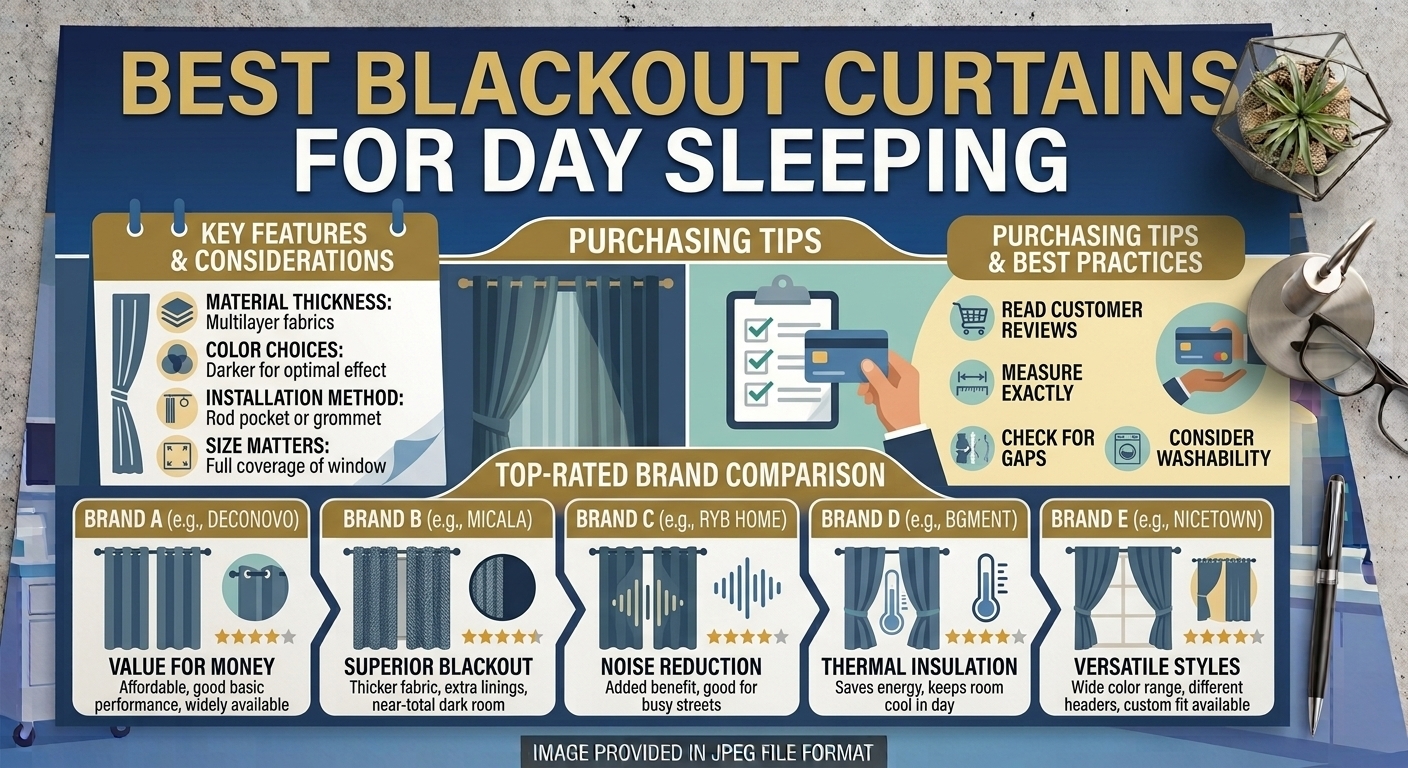
When you are standing in a bright bedroom at 10:00 AM trying to evaluate window coverings, marketing terms like “room-darkening” or “light-filtering” can be misleading. For a night-shift worker, those terms usually mean you will still be squinting in ambient light. True blackout curtains require a specific combination of fabric weight, lining construction, and proper sizing.
Fabric construction makes the biggest difference. High-performance blackout curtains typically use a triple-weave fabric or feature a dedicated, dense black yarn layer sandwiched between decorative face and back fabrics. This multi-layer approach stops light photons from passing straight through the textile fibers.
However, even the thickest fabric will fail if you ignore the window dimensions. A common mistake is buying curtains that match the exact width of the window glass. To block light effectively, your panels need to extend at least three to six inches beyond the window frame on every side. If your curtains only cover the glass, morning sunlight will pour right through the gaps at the left and right edges.
You also have to think about how light enters from the top and bottom. Standard curtain rods leave a gap between the top of the fabric and the wall, letting a bright halo of light spill across the ceiling. Choosing wraparound rods or ceiling-mounted tracks helps minimize this issue. Maintenance is another practical factor; most polyester blackout options are machine washable, but heavy foam-backed models may require more careful handling to avoid damaging the inner lining.
Top Blackout Curtains for Day Picks
Not all light-blocking panels are built the same. We looked at three popular, widely available curtain options that serve different needs for daytime sleepers.
1. NICETOWN Thermal Insulated Blackout Curtains
Best for: Everyday reliability and plenty of color choices without spending a fortune.
NICETOWN panels show up in shift workers’ bedrooms everywhere because they just plain work without needing weird hardware or a complicated install. Instead of using a stiff rubber or plastic backing that eventually cracks and peels after a few months of heat and sun, these use a tight triple-weave fabric. That means the dark light-blocking threads are baked right into the material itself.
They do a solid job cutting out harsh morning rays and keeping the afternoon heat from turning your bedroom into a sweatbox. You hang them on a standard silver grommet top that slides back and forth smoothly on any basic curtain rod. They come in dozens of shades and lengths, from standard 63-inch drops up to long 96-inch and 108-inch options, so finding something that fits your window frame isn’t a headache.
- Main Advantages: Easy on the wallet, huge range of colors and sizes, toss-them-in-the-wash friendly, and no stiff chemical backings to flake off.
- Main Disadvantages: Those standard metal grommet holes leave a tiny open gap right at the top where a sliver of light can sneak across your ceiling unless you swap in a wraparound rod.
- Who Should Buy It: Night-shift workers looking for reliable, straightforward light blocking that won’t break the bank.
- Who Should Skip It: Anyone needing absolute, edge-to-edge blackout performance right out of the box without supplemental hardware.
2. Eclipse Kendall Solid Blackout Window Curtain Panel
Best for: Stopping blazing morning light when you live on a loud, busy street.
If standard curtains still leave your bedroom glowing, you need something heavier. The Eclipse Kendall panel uses a bonded foam backing instead of standard woven layers. That thick rubberized backside acts like a solid shield against the sun, meaning harsh morning rays hit the fabric and stop dead.
Because the material is so dense, it does double duty. It helps block out the roar of delivery trucks and garbage cans rumbling down your street at 9:00 AM, and it keeps your bedroom from turning into an oven when the afternoon sun hits your windows. They are sold individually, which makes it easy to grab three panels if your window frame needs a wider spread.
- Main Advantages: Massive drop in light transmission, great thermal block against afternoon heat, and noticeable dampening of street noise.
- Main Disadvantages: The stiff backing material makes them heavier on the rod, and they usually require gentle care instructions rather than heavy-duty machine washing.
- Who Should Buy It: Shift workers dealing with intense, direct morning sunlight or noisy daytime neighborhoods.
- Who Should Skip It: People who prefer lightweight, flowing curtains that are easy to take down and toss in the regular wash.
3. Deconovo Room Darkening and Blackout Grommet Curtains
Best for: Renters or tight budgets needing quick window coverage without spending a fortune.
If you are watching your spending or renting an apartment where you don’t want to drop a ton of cash on hardware, Deconovo panels are a popular go-to. They are made from a basic, lightweight polyester that won’t strain a cheap tension rod, making them super simple to put up by yourself on your first day off.
The catch with these is the thickness. While dark charcoal or navy versions do a decent job dimming a bright room, picking a lighter color means you’re going to get a noticeable morning glow seeping right through the weave. They feel a bit thin compared to heavy-duty drapes, but they get the job done when you need an affordable fix.
- Main Advantages: Very easy on the wallet, lightweight enough for basic rental rods, and simple to toss in the wash.
- Main Disadvantages: Thinner fabric quality means light filters through pastel or white shades much easier than dark ones.
- Who Should Buy It: Renters or night-shift workers looking for an economical way to darken a bedroom quickly.
- Who Should Skip It: Anyone sleeping in a room with direct, unshaded southern or eastern exposure where every single ray of light causes issues.
Budget vs. Premium — Where Is It Worth Spending More?
When shopping for window treatments, it is easy to wonder if a fifty-dollar panel is really better than a fifteen-dollar one. For daytime sleeping, spending a little more usually gets you two things: denser fabric weaves and better structural weight.
Cheap curtains often use thin, single-layer fabrics with a cheap chemical coating that flakes off after a few trips through the washing machine. Premium panels use heavy triple-weave textures or thick multi-layer construction that drapes cleanly and holds up to years of daily opening and closing.
However, spending top dollar on luxury designer brands doesn’t automatically mean better sleep. Many expensive department store curtains prioritize aesthetic texture over light-blocking density. If your primary goal is blocking the sun so your brain can produce melatonin, look at the fabric weight and backing density rather than the brand name or decorative patterns. Save your money on fancy pleats and invest it in panels that are wide enough and long enough to cover the entire window frame.
[How to Sleep During the Day After a Night Shift]
Installation Tips That Actually Improve Light Blocking
Even the best curtains for sleeping during the day will fail if they are hung incorrectly. Light is clever; it bends around corners and sneaks through tiny cracks. To turn your bedroom into a true cave, use these practical installation adjustments:
First, mount your curtain rod wider than the window frame. If your window is 36 inches wide, buy a rod that extends at least 42 to 48 inches. This allows you to push the open curtains completely clear of the glass when you want light, and gives the panels enough width to overlap the wall by three inches on each side when closed.
Second, mount the rod higher up. Don’t attach it right at the top of the window trim. Move it four to six inches higher toward the ceiling. This prevents the obnoxious halo of light from shining down across the top of your headboard.
Third, deal with the side and bottom gaps. If light still peeks around the edges, consider pairing your curtains with an inside-mount blackout roller blind, or use small adhesive Velcro strips or magnetic weights to pin the inner edges of the curtain panels directly to the wall.
[Napping Strategies for Shift Workers: Science-Backed Timing]
Writer’s Take — My One Pick
If I had to choose just one option from the group for a night-shift schedule, the NICETOWN Thermal Insulated Blackout Curtains take the top spot.
They strike the best balance between everyday practicality, cost, and real-world performance. Because they use a heavy triple-weave fabric rather than a peeling rubber backing, they hold up well to regular washing, drape naturally, and come in enough sizes to fit almost any bedroom layout. While they aren’t custom-made architectural seals, pairing them with a wraparound rod gives you 95 percent of the dark sanctuary you need without spending a fortune.
The main limitation is that standard grommets let a little light sneak over the top, but a simple ceiling-mounted track or higher rod placement easily fixes that issue. For most night-shift workers looking for an immediate, reliable upgrade to their sleep environment, this is the most sensible starting point.
Frequently Asked Questions
Do blackout curtains really block all light?
High-quality blackout curtains can block nearly all the light that hits the fabric itself, but they rarely create 100 percent total darkness on their own. Light can still sneak in around the top, bottom, and side edges of the window frame. Achieving true pitch-black conditions usually requires combining good curtains with wraparound hardware or secondary blinds.
Are blackout curtains worth it compared with using an eye mask alone?
While sleep masks are great for travel or temporary fixes, blackout curtains transform your entire bedroom environment. They help regulate room temperature, dampen street noise, and eliminate the physical irritation of having something strapped to your face for eight hours.
How do I stop light from leaking around the edges of blackout curtains?
You can stop edge leaks by using a wraparound curtain rod that curves back to meet the wall, extending the rod several inches past the window frame, and mounting the hardware closer to the ceiling. For stubborn gaps, some people use small magnetic strips or Velcro to secure the curtain edges directly to the wall.
Can blackout curtains help keep my bedroom cool during summer day sleeping?
Yes. Quality blackout curtains with thermal-insulating layers help block radiant solar heat from entering through glass windows. This makes it much easier to keep your bedroom cool during afternoon hours when you need restful daytime sleep.
Sources
- U.S. Department of Energy — Energy-Efficient Window Coverings: energy.gov/energysaver/energy-efficient-window-coverings
- Sleep Foundation — Light Exposure and Sleep: sleepfoundation.org/sated/light-exposure-and-sleep

Daniel Carter is the founder of NightShiftWell. He spent over a decade working night and rotating shifts in logistics and warehouse operations before starting this site to share what actually works — and what doesn’t — for staying healthy on an inverted schedule.