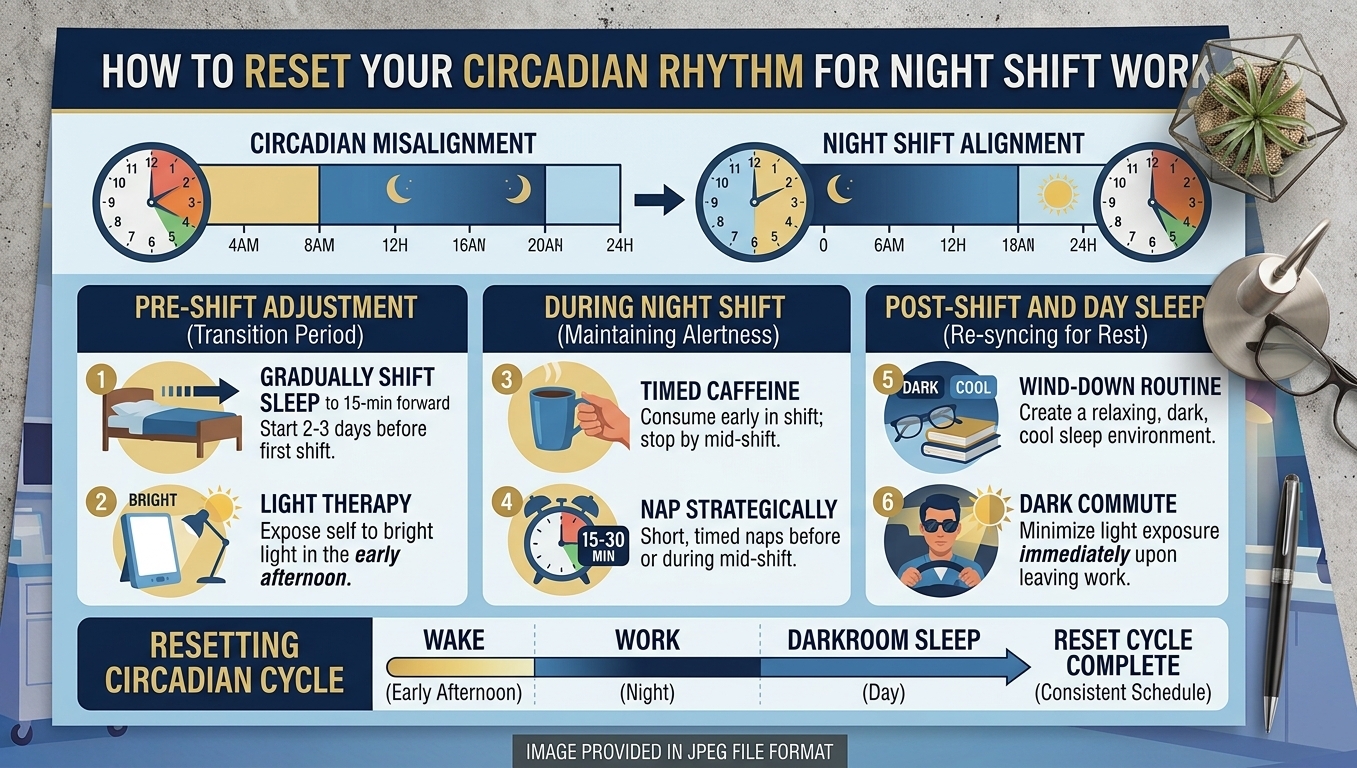
Last updated: September 29, 2026
Medically reviewed by: Dr. Emily Carter, MD , Board-Certified Family Medicine Physician
Your phone alarm starts blasting at 4:30 in the afternoon. You pull yourself out of bed, but your legs feel heavy and your head is pounding. You spent the entire night staring at office computers or hospital monitors, got home just as your neighbors were leaving for their morning commutes, and tried to sleep while the sun beat down on your windows. Now, you have to get ready to do it all over again. You stare into the bathroom mirror, completely exhausted, wondering why your body refuses to accept that night is your new day.
When you move from day shifts to a night schedule or start working rotating hours, your life turns upside down. You try to sleep when the world is wide awake, and you try to stay sharp when your body desperately wants to shut down. If you feel like your internal clock is completely broken, you are not imagining things. Your biology is caught in a tug-of-war.
What’s Actually Happening in Your Body When You Switch Shifts
Your body runs on a strict internal 24-hour master clock known as the circadian rhythm. This biological timer lives deep inside your brain. It does not care that your boss changed your schedule or that your contract says you work from midnight to 8 AM.
For most of human history, our ancestors woke up with the sun and slept in the dark. Your master clock still operates on that ancient rulebook. It expects daylight to mean activity and darkness to mean rest. When you start working overnight, you introduce a massive conflict into your system.
The National Institute for Occupational Safety and Health (NIOSH) points out that night-shift work forces your body to try to sleep during its natural biological day and work during its biological night. Your internal organs, digestive tract, and hormone levels all follow this internal rhythm. When you force yourself awake at 3 AM, your body is still trying to lower your core temperature and release melatonin, the hormone that tells you to sleep.
This mismatch explains why you feel so groggy during your shift. It also explains why your daytime sleep feels light, broken, and unrefreshing. The change does not happen overnight. Your internal clock resists the new schedule because millions of years of human evolution programmed it to do exactly that.
Light Exposure—The Single Biggest Lever
If you want to help your body adapt to a new shift schedule, you have to understand how your brain reads light. Light acts as the primary remote control for your circadian rhythm.
When morning sunlight hits the special sensors in your eyes, your brain receives an immediate signal to stop producing melatonin. It boosts your alertness by releasing cortisol and raising your body temperature. For a day worker, this morning light is helpful. For a night worker driving home at sunrise, it is a disaster.
That morning commute home can single-handedly ruin your ability to sleep. If you drive home without sunglasses, the bright morning sky tricks your brain into thinking it is time to start a brand-new day. Your internal clock resets itself right as you are trying to get into bed.
According to research published in the journal Sleep, controlling light exposure through strategic timing can help shift workers shift their circadian phase more effectively. During your night shift, exposure to bright artificial office or warehouse lighting can help signal to your brain that you need to stay awake and alert. Conversely, avoiding bright light as your shift ends—such as wearing dark sunglasses on your drive home—helps protect your remaining melatonin and makes it much easier to fall asleep once your head hits the pillow.
However, light management is not a magic switch. The effect depends heavily on timing, intensity, duration, and your specific work schedule. You cannot simply sit under a desk lamp for ten minutes and expect your body to ignore a rotating schedule. Light exposure works gradually, nudging your biology over days and weeks rather than rewriting it instantly.
A Realistic Transition Timeline — This Isn’t Instant
Many new night-shift workers make the mistake of expecting their bodies to fully adjust within forty-eight hours. They finish two night shifts, sleep poorly during the day, try to stay awake on their off day, and feel completely broken by the time their next shift rolls around.
Real biological adjustment takes time. In many cases, the human circadian rhythm never fully shifts to match a permanent night schedule because society still operates on a daytime calendar. On your days off, you likely run errands, spend time with family in the daylight, and revert back to a standard daytime schedule.
Research highlighted by the Centers for Disease Control and Prevention (CDC) notes that frequent schedule changes create chronic circadian disruption. If you work three night shifts followed by two day-off shifts where you sleep at night, your body never gets a chance to settle. You spend your entire life in a state of jet lag.
During a transition period, you can expect to experience persistent fatigue, brain fog, irritability, and fragmented sleep. Some workers adapt slightly better than others due to age, genetics, and sleep debt, but no one adjusts overnight. Accepting that you will feel somewhat tired during the first few weeks helps you manage your expectations and protect your recovery time without panicking.
What Doesn’t Work—Common Mistakes
When exhaustion sets in, it is easy to fall into habits that make circadian disruption much worse. Avoiding these common traps is just as important as building good sleep habits.
- Trying to flip your schedule on your days off: Spending your entire weekend sleeping at night and staying up late during the week forces your body to reset its clock twice every single week. This constant back-and-forth causes severe social jet lag and leaves you perpetually exhausted, fighting a losing battle against your own biology before your next shift even starts.
- Ignoring light during your commute home: Walking out of a dark workplace straight into blinding morning sunlight tells your brain the day has begun, completely sabotaging your sleep onset.
- Sleeping in a bright, noisy environment: Leaving your blinds open in the room or keeping the television on prevents your brain from entering deep, restorative slow-wave sleep, which is the need of an hour for you after the night shift duty. Every passing car horn and beam of sunlight keeps your nervous system on guard, robbing you of the physical repair time you earned on the clock.
- Relying on caffeine until the end of your shift: Gulping down an energy drink or a strong cup of coffee right as your shift wraps up—or even four hours before—is a recipe for insomnia. Caffeine stays active in your bloodstream for hours, blocking the chemical receptors that tell your brain it is time to wind down. Research published in the Journal of Clinical Sleep Medicine points out that consuming caffeine late in your shift delays sleep onset and sharply cuts down your total hours of rest.
- Staying awake all day to “reset” your clock: Forcing yourself to stay awake for twenty hours straight after a night shift just to sleep at night usually backfires, resulting in extreme exhaustion, disorientation, and poor sleep quality.
If You Change One Thing, Start With Light
If you take away only one actionable strategy from this entire guide, make it this: manage your light exposure, especially during the transition off your shift.
You can buy expensive mattresses, experiment with endless supplements, and try every relaxation app available, but if you let bright morning sunlight flood your eyes on the drive home, your internal clock will override everything else. Light is the absolute master regulator of your circadian rhythm.
When your night shift wraps up, put on dark sunglasses before you step outside. Keep your car interior dim. When you get home, walk into a bedroom equipped with heavy blackout curtains or a tight-fitting sleep mask. By shielding your eyes from morning light, you protect your body’s natural wind-down process. Lock down your light exposure first, and the rest of your sleep routine will finally have a fighting chance to work.
Frequently Asked Questions
How long does it take to adjust to the night shift?
Most shift workers never fully adjust to night shifts because natural daylight and social obligations pull their internal clocks back toward a daytime schedule. Minor improvements in sleep quality can appear within a week or two of strict consistency, but complete biological adaptation is rare for rotating or irregular schedules.
Do blue-light glasses help?
Blue-light-blocking glasses can help reduce the alerting effects of artificial lighting during your shift or block morning sunlight on your commute home or whatever the spot you use for sleeping. While they are not a cure-all, wearing them during the final hours of your shift or on the drive back can make it easier to wind down for daytime sleep.
What if I only work nights 3 days a week?
Working only a few night shifts per week makes a permanent circadian reset nearly impossible. For a partial schedule, it is often better to maintain a hybrid sleep schedule, taking strategic daytime naps on work days while preserving a more traditional nighttime sleep schedule on your days off.
Does going back to a day schedule on off days reset your progress?
Flipping back to a daytime schedule on your days off repeatedly disrupts your circadian rhythm, creating a continuous cycle of biological jet lag. While it allows you to spend time with family during the day, it guarantees that you will feel fatigued when returning to your next night shift.
Closing
Before your next night shift ends, set out your dark sunglasses by the door and make sure your bedroom curtains are pulled tight. When you leave work tomorrow morning, put on your glasses immediately, drive home without exposing your eyes to direct morning glare, and head straight to your dark, quiet sleep sanctuary.
Sources
- National Institute for Occupational Safety and Health (NIOSH): Plain Language About Shiftwork
- Centers for Disease Control and Prevention (CDC): Sleep and Shift Work
- Journal of Clinical Sleep Medicine: Insomnia in Shift Work Disorder Relates to Occupational and Neurophysiological Impairment
- Current Biology: Entrainment of the Human Circadian Clock to the Natural Light-Dark Cycle

Daniel Carter is the founder of NightShiftWell. He spent over a decade working night and rotating shifts in logistics and warehouse operations before starting this site to share what actually works — and what doesn’t — for staying healthy on an inverted schedule.