Last updated: September 29, 2026
Medically reviewed by: Dr. Emily Carter, MD , Board-Certified Family Medicine Physician
Struggling to sleep through daytime noise? Compare the top white noise machines tested for shift workers to block traffic, neighbors, and daylight disruptions.
Finding the Best White Noise Machine for Shift Workers to Block Daytime Chaos
NightShiftWell may earn a commission if you buy through links in this article. This does not affect how we evaluate products or the price you pay.
The alarm goes off at 7:00 AM, but you are just getting home from a brutal 12-hour night shift. You close the heavy curtains, crawl into bed, and wait for sleep to take over. Then the neighbor decides that Tuesday morning is the exact right time to prune the hedge with a gas-powered weed whacker. Five minutes later, a delivery truck idles loudly right outside your bedroom window, and someone starts hammering nails into a roof three houses down. Your body wants to sleep, but your environment is working against you.
Daytime sleep is a battle against the world’s natural rhythm. When you work nights, rotating shifts, or irregular schedules, you have to sleep while the rest of the neighborhood is wide awake. Total silence is almost impossible to find during the day. That is why many night workers rely on a dependable white noise machine for shift workers to create an auditory shield, making sudden loud noises blend into the background instead of jolting the brain awake.
How White, Pink, and Brown Noise Actually Work
People often use the term “white noise” for any sound machine, but acoustic profiles actually vary quite a bit. Understanding these differences helps you pick a machine that targets your specific sleep disruptions.
White noise contains equal energy across all audible frequencies. White noise sounds like old TV static or a hard bathroom shower. Because it hits every sound frequency the exact same way, it cuts right through sharp, annoying noises like a slammed door or a barking dog.
Pink noise rolls off the high notes. It ends up sounding much softer and deeper, like steady rain hitting a roof or wind moving through trees. Think of steady rainfall, rustling leaves, or a gentle wind. Many people find pink noise less harsh on their ears over a long, eight-hour sleep window compared to bright white noise.
Brown noise drops off even faster at higher frequencies, leaving behind a deep, heavy, rumbling sound. It resembles a distant thunderstorm or a powerful waterfall. If your main daytime sleep enemies are low-frequency sounds—like heavy truck engines, bass from a neighbor’s television, or construction rumbling down the street—brown noise offers the thickest barrier.
None of these sounds actually delete noise from your room. Instead, they narrow the gap between your baseline background sound and sudden loud spikes. By lowering that contrast, your brain is far less likely to register a micro-arousal that pulls you out of deep sleep.
Best White Noise Machines for Shift Workers
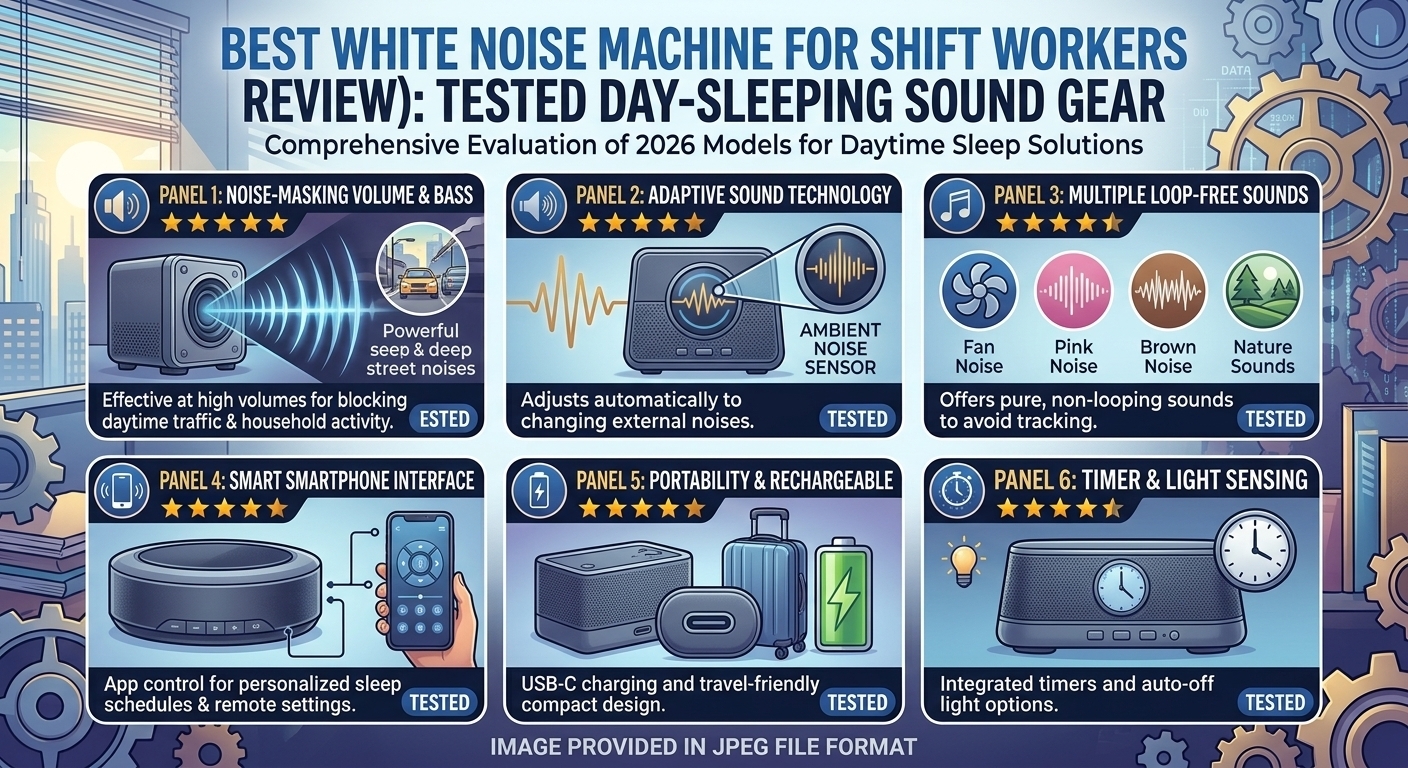
Choosing a sound machine for shift work requires looking beyond a massive list of built-in sound effects. You need reliable volume control, non-looping audio that won’t drive you crazy over an eight-hour sleep block, and a footprint that fits your lifestyle. Here are four current options evaluated for daytime sleepers.
1. Dreamegg 10W Powerful Sound Machine
Best for: Most cheap sound machines use tiny 3-watt or 5-watt speakers. Turn them up to block out afternoon traffic, and the audio starts rattling or distorting.
Why it stands out: The Dreamegg 10W handles that differently. It uses a much bigger internal speaker driver. That means you get deep, full sound and plenty of volume headroom to bury low-end city rumbles and street noise without ruining the audio quality.
- Pros: Generous volume range (up to 87 dB), excellent deep-frequency brown noise reproduction, built-in Bluetooth for waking hours, and lab-validated noise reduction performance.
- Cons: Bluetooth mode will drain battery life faster if run unplugged; the physical unit is slightly heavier and bulkier than pocket-sized travel units.
- Who should buy it: Shift workers who live near busy streets, construction sites, or noisy upstairs neighbors who need real acoustic power to bury low-end rumbles.
- Who should skip it: Light sleepers who only need a tiny, whisper-soft background hiss and want a featherlight device for constant travel.
2. Magicteam Sound White Noise Machine
Best for: Budget-conscious workers who want a wide selection of sounds without a steep price tag.
Why it stands out: Tens of thousands of buyers love it because the audio does not loop. Cheap machines repeat every thirty seconds, and your brain quickly catches the pattern and wakes you up.
- Pros: Twenty steady sounds, thirty-two volume steps, simple memory recall, and wall plug or USB power.
- Cons: Build quality feels a bit lightweight; some long-term users note that buttons can become stiff after more than a year of daily pressing.
- Who should buy it: Nurses, factory workers, and retail staff looking for a reliable, inexpensive bedroom unit that offers plenty of audio variety.
- Who should skip it: Anyone who prefers analog mechanical switches over digital push buttons and tiny display lights.
3. Yogasleep Dohm Classic
Best for: Sleepers who want real mechanical fan sound instead of digital loops.
Why it stands out: It does not use a digital audio file or a speaker. A small internal motor spins a real fan blade inside an acoustic housing. That mechanical airflow creates a natural, shifting sound that digital recordings have a hard time copying.
- Pros: No repeating audio files, a simple two-speed switch for changing tone, a heavy plastic shell, and old-school manual dials that never crash.
- Cons: You get one basic fan sound with no nature options, no automatic shut-off timer, and it takes up more nightstand space than mini units.
- Who should buy it: Shift workers who find that digital white noise sounds artificial or annoying over long periods and want genuine mechanical airflow sound.
- Who should skip it: Travelers who need a lightweight device that packs flat into a suitcase or anyone who wants rain and nature sounds.
4. Hushing Sound Machine Mini
Best for: Traveling workers, flight crews, and hospital personnel who sleep in changing locations.
Why it stands out: This ultra-compact device measures less than two inches across yet packs a 32-hour rechargeable battery. It solves the primary frustration of portable sound machines: dying batteries halfway through a daytime sleep session.
- Pros: Incredible 32-hour battery life on a single charge, 30 non-looping sounds, lightweight form factor, and convenient USB recharging.
- Cons: Small speaker size struggles to fill massive bedrooms with high ceilings; max volume is lower than plug-in powerhouse units.
- Who should buy it: Truck drivers sleeping in sleeper cabs, travel nurses changing hotels every few weeks, and anyone who needs a pocket-sized sleep aid.
- Who should skip it: Homeowners sleeping in large, loud bedrooms right next to a busy highway who need heavy room-filling audio power.
| White Noise Machine | Best For | Main Strength | Main Drawback |
| Dreamegg 10W | Heavy noise masking | Powerful 10W driver & deep brown noise | Bulky for travel |
| Magicteam Sound Machine | Budget-friendly variety | 20 non-looping sounds & 32 volume levels | Lightweight plastic build |
| Yogasleep Dohm Classic | Natural fan sound | Real internal mechanical fan | Single sound type only |
| Hushing Mini | Ultimate portability | 32-hour rechargeable battery | Lower max volume output |
App-Based Alternatives: Are They Good Enough?
With smartphones already sitting on our nightstands, downloading a free or paid white noise app seems like the easiest choice. After all, apps offer hundreds of sound choices, timers, and automatic shut-offs without requiring any extra gadget purchases.
For occasional travel or testing out whether white noise helps you sleep, an app on an old tablet or a secondary phone works fine. However, using your primary smartphone as a sound machine introduces major risks for shift workers.
First, phones bring notifications. Even on “Do Not Disturb,” a stray text message alert, emergency broadcast, or group chat ping can punch right through your sleep cycle. Second, keeping your phone screen active or running audio apps all night drains the battery and generates heat. Finally, picking up your phone to adjust the sound exposes your eyes to blue light right when you are trying to convince your brain that it is nighttime.
A dedicated white noise machine for sleeping keeps your phone out of reach, runs reliably without cellular distractions, and preserves your phone battery for your actual shift. Dedicated hardware wins for long-term daily use.
Where to Put a White Noise Machine for the Best Effect
Owning the right machine is only half the battle. If you place it in the wrong spot in your bedroom, its noise-masking power drops significantly.
Many people make the mistake of putting their sound machine on a nightstand directly beside their pillow at maximum volume. Running a speaker at high decibels right next to your ear for eight straight hours can strain your hearing over time.
Instead, position the machine closer to the source of the noise. If traffic or lawnmowers outside the window are waking you up, place the white noise machine on a dresser or shelf near that window. This creates an acoustic barrier that intercepts outside sounds before they travel across the room to your bed.
Keep the volume at a moderate level—roughly enough to gently mask outside disturbances without forcing you to strain to hear yourself think when you wake up. According to hearing health organizations like the National Institute for Occupational Safety and Health (NIOSH), keeping continuous background sounds below safe thresholds prevents ear fatigue while still providing effective sleep masking.
Writer’s Pick for Travel and Room-Swapping
For anyone who travels for work, moves between different rooms, or needs a reliable device that can handle unpredictable schedules on the road, the Hushing Sound Machine Mini is the single best choice.
Its 32-hour battery life means you do not have to hunt for a wall outlet near the bed, and its palm-sized design slips easily into a backpack or work bag. It provides enough non-looping sound variety to handle strange hotel rooms, noisy truck stops, or quiet guest rooms without taking up valuable luggage space.
Frequently Asked Questions
Is white noise bad for your hearing over time?
White noise is safe for your hearing as long as you keep the volume at a moderate level. According to the Centers for Disease Control and Prevention (CDC) and hearing health experts, continuous sound levels below 70 to 75 decibels generally do not pose a risk to hearing health over long periods. Do not place the machine directly against your ear at maximum volume.
What’s the difference between white and brown noise?
White noise sounds like bright, rushing television static because it distributes energy evenly across all high and low frequencies. Think of brown noise as a deep, rolling rumble, like a heavy thunderstorm far off in the distance or a massive waterfall. It cuts out the high-pitched hiss entirely. Because it leans heavily into low frequencies, it does a fantastic job of swallowing up the vibrations of heavy trucks, low-end bass from next door, and rumbling street traffic. That is why so many night workers stick with brown noise when trying to block out daytime city noise.
Do white noise machines work as well as noise-cancelling headphones?
They solve different problems. Active noise-cancelling headphones use electronics to phase out predictable, steady background hums like airplane engines, but wearing bulky headphones while sleeping on your side is uncomfortable and impractical. A white noise machine fills the entire room with a gentle audio blanket, masking sudden unpredictable sounds without anything touching your head.
Sources
- Centers for Disease Control and Prevention (CDC). “Noise and Hearing Loss Prevention.” cdc.gov/nceh/hearing_loss/
- National Institute for Occupational Safety and Health (NIOSH). “Noise and Hearing Loss.” cdc.gov/niosh/topics/noise/
- Sleep Foundation. “White Noise for Sleep.” sleepfoundation.org/noise-and-sleep/white-noise

Daniel Carter is the founder of NightShiftWell. He spent over a decade working night and rotating shifts in logistics and warehouse operations before starting this site to share what actually works — and what doesn’t — for staying healthy on an inverted schedule.