Last updated: September 29, 2026
Medically reviewed by: Dr. Emily Carter, MD , Board-Certified Family Medicine Physician
Find the best nap length for shift workers, learn how to avoid grogginess, and discover how to use pre-shift and mid-shift naps safely.
You lean back in the break room chair, close your eyes for what feels like five minutes, and wake up to your alarm. Instead of feeling refreshed, your head feels thick, your limbs are heavy, and you are far more confused and exhausted than before you lay down. It feels like your brain is wrapped in cotton wool, and now you have to stumble back onto the floor to finish your shift.
Every shift worker knows that resting during irregular hours can easily backfire. When you are running on empty, taking a quick rest sounds like the obvious fix, but random naps often leave you worse off. Figuring out the best nap length for shift workers means understanding how your body moves through sleep cycles so you can wake up sharp instead of stuck in a fog.
The Nap-Length Sweet Spot — Why 20 Minutes vs. 90 Minutes Matters
To understand why a quick rest can either save your shift or ruin it, you have to look at what happens inside your brain when you close your eyes. Sleep is not a flat state; it moves through distinct stages, starting light and eventually shifting into slow-wave deep sleep and rapid eye movement (REM) sleep.
When you wake up abruptly from the middle of deep sleep, your brain experiences a phenomenon called sleep inertia. This is that heavy, disoriented hangover feeling that makes simple tasks feel impossible. Sleep inertia doesn’t mean you slept wrong; it simply means your brain was dragged out of a restorative stage before it was ready.
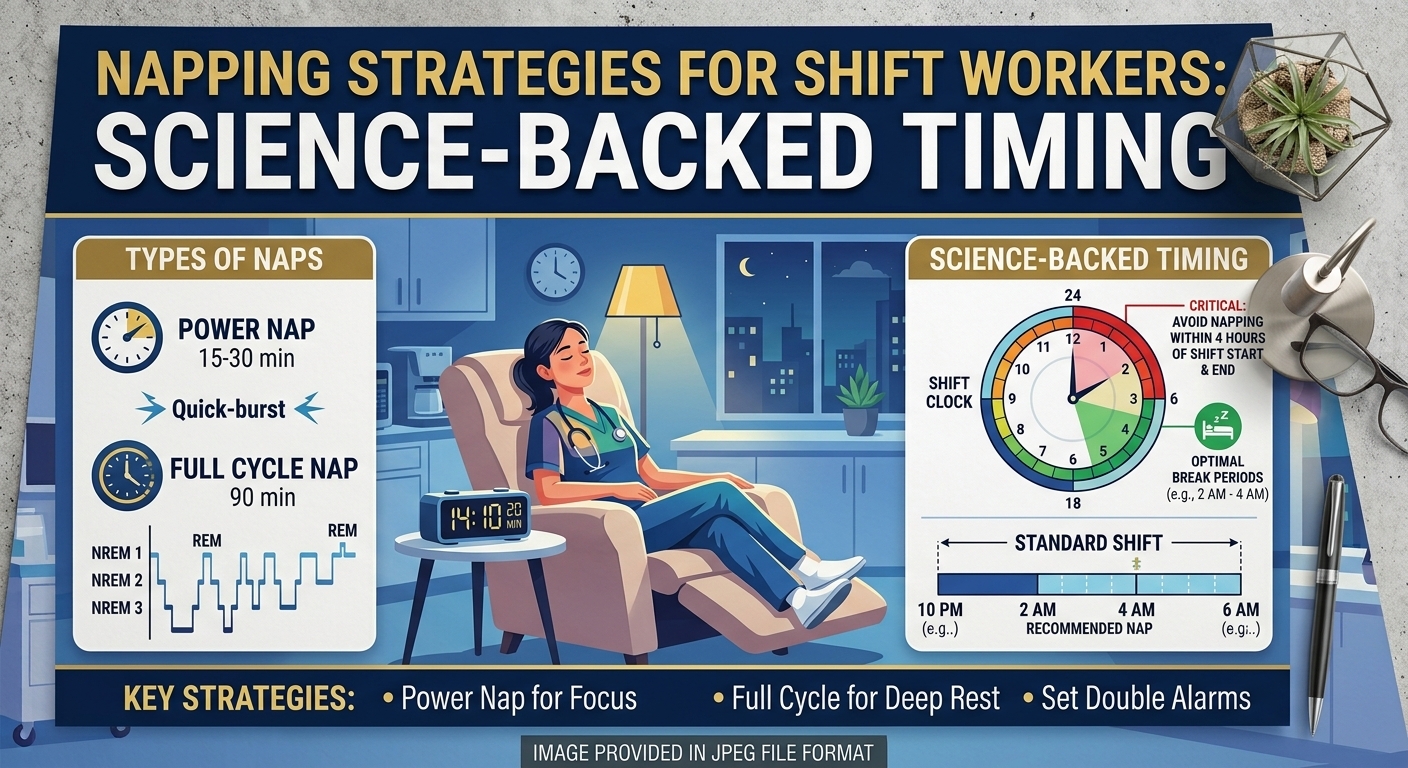
This is why different nap lengths serve completely different purposes. A short nap lasting 10 to 20 minutes keeps you in the lighter stages of sleep. According to fatigue guidance from the National Institute for Occupational Safety and Health (NIOSH), short rest breaks can help restore alertness and improve performance without plunging you into deep sleep, making it much easier to wake up clear-headed.
On the other hand, if you have enough time to complete a full sleep cycle—which usually takes about 90 minutes—your brain moves through light and deep sleep and naturally cycles back toward lighter sleep before your alarm goes off. Well-known research from NASA on military pilots and astronauts found that a planned 26-minute nap improved alertness and performance significantly, while longer consolidated rest blocks like a 90-minute cycle helped restore cognitive function when cumulative sleep debt was high.
There is no single magic number that works identically for every single person. How you respond depends on how sleep-deprived you are, how fast you fall asleep, and where your circadian rhythm is sitting at that moment. But knowing the difference between a quick power reset and a full cycle helps you match your rest to the time you actually have.
Pre-Shift Naps vs. Mid-Shift Naps — Different Purposes
Shift workers often treat any daytime sleep the same way, but a nap taken before you leave for work has a completely different job than a nap taken on a break during your shift.
Pre-Shift Naps
A pre-shift nap, sometimes called a prophylactic nap, is designed to build a safety buffer before you face a long stretch of overnight work. If you know you have a grueling 12-hour shift ahead, sleeping for 90 minutes to two hours in the late afternoon or early evening can top off your energy tank before the sun goes down.
This strategy is especially useful if your main daytime sleep after your previous shift was cut short by noise, light, or family responsibilities. Taking a pre-shift nap acts as extra armor against the 3 AM fatigue wall. It is not meant to replace your primary sleep block, but rather to give you a running start before you punch in.
Mid-Shift Naps
A mid-shift nap happens right in the middle of the chaos. If your workplace provides a quiet space or a designated rest area, a short 15-to-20-minute nap during a scheduled break can pull you back from the edge of exhaustion.
The goal here is not deep recovery; it is tactical maintenance. You are simply trying to shed enough sleep pressure to get safely through the second half of your shift. Because break times are usually short, keeping this nap brief protects you from waking up deep in sleep inertia right when you need to return to your duties. Not every workplace makes mid-shift resting easy, but where it is allowed, a short, disciplined break can change the trajectory of an overnight shift.
How to Avoid Sleep Inertia
Waking up feeling like you are moving underwater can derail your entire workflow. While you cannot completely erase the risk of sleep inertia, you can manage it with a few practical habits.
First, match your nap duration to your timeline. If you only have a 25-minute break, do not attempt a 90-minute sleep cycle, because your alarm will pull you straight out of slow-wave sleep. Stick to a short 15-to-20-minute window.
Second, give yourself a transition buffer after you wake up. If your job involves safety-critical tasks, driving, or operating machinery, never jump straight back to work the exact second your alarm sounds. Give yourself 15 to 20 minutes of leeway to let the grogginess clear.
Third, use sensory cues to help wake your nervous system up. Splashing some cool water on your face, stepping under bright lights, or chugging a glass of cold water can make that foggy post-nap transition a lot faster.
[How to Stay Awake During a Night Shift Naturally]
A Sample Nap Schedule for a Typical Night Shift
To see how these pieces fit together, consider a worker on a standard 7 PM to 7 AM night shift. Seeing a realistic timeline can help you map out your own rest without guessing.
- 8:00 AM to 3:30 PM (Main Sleep): This is your core sleep window. You’ll want to lock yourself in a dark, quiet room with proper blackout curtains to make sure your brain actually gets the deep rest it needs during the day.
- 4:00 PM to 5:30 PM (Optional Pre-Shift Nap): If your sleep yesterday was short, choppy, or just plain terrible, try squeezing in a full 90-minute sleep cycle right before your evening starts.
- 1:00 AM to 1:20 AM (Mid-Shift Nap): When that brutal middle-of-the-night slump hits, use a quick 20-minute power nap on your break to clear out the heavy fatigue before your body’s internal clock bottoms out.
- 1:20 AM to 1:40 AM (Buffer Zone): Don’t jump straight back into hard work right after your eyes open. Take a quick minute to stretch your legs, grab a sip of cold water, and shake off any remaining fog before you jump back into what you were doing.
Keep in mind that this schedule is just a rough template, not a strict rule you have to follow to the letter. Your exact timing will shift based on your commute, family life, and whether your workplace permits mid-shift breaks. The underlying principle remains the same: protect your main sleep, use pre-shift rest to add a safety buffer, and keep mid-shift naps short unless you have the time to complete a full cycle.
Writer’s Take
If you are new to strategic napping, the single best habit you can adopt is committing to the short 20-minute reset.
It is tempting to think that longer is always better, so workers try to squeeze a chaotic 45-minute nap into a tight break, only to wake up feeling completely wrecked by sleep inertia. A 20-minute nap is reliable precisely because it stays safely away from deep sleep stages. It gives your brain a quick pause, drops your heart rate for a moment, and lets you step back onto the floor with a clearer head.
The main limitation is that a short nap won’t fix deep, chronic sleep debt. If you are running on three hours of sleep for four days straight, a 20-minute break is just a Band-Aid on a broken bone. But for managing a single overnight shift, it is one of the cleanest, most predictable tools you have.
[Caffeine Timing for Night Shift Workers: When to Drink It and When to Stop]
FAQ
Is a 20-minute nap really enough?
Yes, a 20-minute nap is usually enough to take the edge off acute fatigue and boost your alertness without plunging you into deep sleep. Because you stay in the lighter stages of rest, you avoid heavy sleep inertia and can return to work quickly.
What if I can’t fall asleep in 20 minutes?
Even if you do not completely drift off, simply lying quietly with your eyes closed in a dark, low-stimulus environment gives your nervous system a valuable rest. That quiet downtime still lowers your heart rate and provides a minor restorative benefit.
Do naps ruin nighttime sleep?
When timed correctly, short strategic naps during a night shift do not ruin your ability to sleep during the day. However, taking long naps too close to your planned main sleep window can steal your sleep pressure and make it harder to fall asleep later.
Are workplace nap pods worth using if available?
Nap pods and designated quiet rooms can be genuinely helpful by blocking out light and noise in busy work environments. They are a great tool for privacy and comfort, though a simple reclining chair in a quiet, dark room accomplishes the exact same physiological goal.
Sources
- National Institute for Occupational Safety and Health (NIOSH). NIOSH Training for Nurses on Shift Work and Long Work Hours. Centers for Disease Control and Prevention. https://www.cdc.gov/niosh/work-hour-training-for-nurses/
- Sleep Foundation. Shift Work Disorder and Fatigue Management. https://www.sleepfoundation.org/shift-work-disorder
- Rosekind, M. R., et al. Alertness Management: Strategic Naps in Operational Settings. National Aeronautics and Space Administration (NASA).

Daniel Carter is the founder of NightShiftWell. He spent over a decade working night and rotating shifts in logistics and warehouse operations before starting this site to share what actually works — and what doesn’t — for staying healthy on an inverted schedule.