Last updated: September 29, 2026
Medically reviewed by: Dr. Emily Carter, MD , Board-Certified Family Medicine Physician
Discover practical, non-caffeine ways to stay alert during a night shift and protect your focus when exhaustion hits.
You look at the clock, and it’s 3 AM. The shift started out fine, but suddenly your eyelids weigh a ton. Your brain is fogging up, and the easy stuff you normally do without thinking now feels completely exhausting. You still have several hours of work left before you can even think about heading home.
If you work overnight, this scene probably feels familiar. You aren’t lazy, and you didn’t just pick the wrong job. Your body is fighting millions of years of human biology. When you try to stay alert through the dark hours, you are working against your internal clock. Figuring out how to stay awake during night shift naturally comes down to understanding how your body works and using the right tools at the right time.
Why the Circadian Dip Happens
To understand why 3 AM feels like running through wet cement, you have to look at your circadian rhythm. This is your body’s natural 24-hour internal clock. It runs the show behind the scenes, deciding when you’re ready to tackle the day and when it’s time to crash by tweaking your core temperature and pumping out sleep hormones like melatonin.
Even if you managed a full day’s rest before punching in, your brain didn’t get the memo—it’s hardwired to treat darkness as bedtime. Studies in Occupational and Environmental Medicine show that focus and energy take a massive hit overnight, bottoming out hard in those brutal pre-dawn hours. During this window, your brain temperature drops, your alertness bottoms out, and your biological drive for sleep reaches its daily peak.
This is why willpower alone rarely works at 4 AM. Your body is actively trying to shut down. Knowing that this dip is biological rather than a personal failure can make it a little easier to manage. Instead of fighting your biology with pure grit, you have to use targeted strategies to signal alertness to your nervous system.
Movement and Light — The Two Most Effective Non-Caffeine Tools
When the midnight slump turns into deep exhaustion, you need reliable ways to wake your brain up without relying entirely on another cup of coffee. Two of the most powerful tools available are physical movement and smart light exposure.
Movement
Staying completely still at a desk, control panel, or workstation makes fatigue ten times worse. When your body stops moving, your brain gets the message that it is time to wind down.
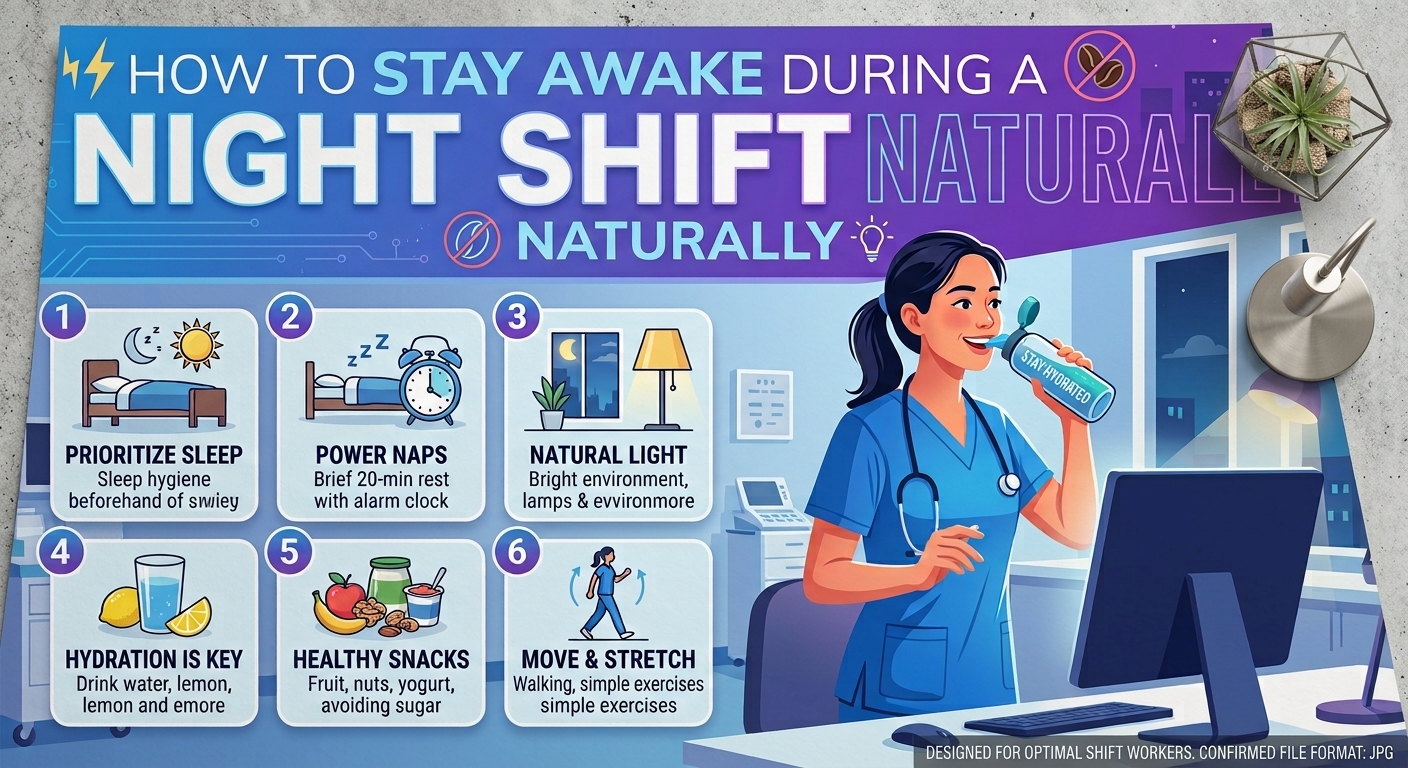
You don’t need to run a marathon or start doing pushups in the middle of a busy floor. The goal is simply to interrupt long periods of sitting. If your workplace allows short breaks, take a brisk five-minute walk down the hallway or up a flight of stairs. Even standing up to stretch your legs, rotate your shoulders, and move around for a couple of minutes can raise your heart rate slightly and bring a quick rush of alertness. Movement acts as a physical wake-up call to your nervous system, reminding your brain that you are still active.
Light
Then there’s light—the main switchboard for your internal clock. Getting hit with bright light early in your shift tricks your brain into thinking it’s daytime, which helps hold off sleepiness and keeps your head in the game.
If you’re stuck working under weak overhead bulbs, keeping a portable light therapy box right on your desk can completely change the vibe. But fair warning: light is a double-edged sword for night-shifters. While bright light helps you stay awake on the job, it can work against you when your shift ends. Exposing your eyes to intense light on your commute home signals your brain to wake up right when you need to fall asleep. Using sunglasses on the drive home helps protect the circadian adjustment you worked all night to maintain.
[How to Sleep During the Day After a Night Shift]
Strategic Caffeine Use
“Natural” doesn’t mean you have to banish caffeine forever. Most night workers rely on coffee, tea, or energy drinks to stay afloat, and caffeine can be a helpful tool when used with care.
The secret is timing. Caffeine blocks the brain chemicals that make you feel sleepy, but it stays in your system for hours. Drinking a large energy drink at 5 AM might get you through the last hour of your shift, but it will likely ruin your ability to get deep, restorative sleep once your head hits the pillow at home.
[Caffeine Timing for Night Shift Workers: When to Drink It and When to Stop]
Front-loading your caffeine to the beginning of your shift and stopping several hours before you clock out lets you enjoy the alertness boost without paying for it with a restless, broken sleep cycle during the day.
What Doesn’t Actually Work
When you are desperately tired at 4 AM, it is easy to fall for quick fixes that promise instant energy. While some of these tricks give you a fleeting sensation of being awake, they rarely solve the underlying fatigue.
Take sugar, for example. Grabbing a candy bar or a pastry from the vending machine gives you a quick spike in blood sugar, but it is almost always followed by an aggressive crash. Within an hour, you will likely feel even sleepier than you did before.
Loud music or talk radio can keep your brain mildly entertained, but background noise cannot override a sleep-deprived nervous system. After a short while, your brain tunes it out, and the heavy exhaustion returns.
Splashing cold water on your face provides a sharp, refreshing shock that feels great for about sixty seconds. It is a nice temporary distraction, but it doesn’t change your core body temperature or reduce your biological sleep pressure. None of these quick tricks can ever replace what your body actually needs: proper rest.
Writer’s Take
If you ask me what the single most underrated strategy is for surviving the night shift, my vote goes to the planned movement break.
Most night workers wait until they are nodding off before they try to do something about it. By that point, your brain is already fighting a losing battle. The trick is to schedule short, deliberate bouts of movement before the slump hits—say, right around 1:30 AM before the 3 AM wall arrives.
It is underrated because it sounds too simple to work. People want a complex supplement or a high-tech gadget. But getting up, walking briskly for three minutes, and drinking a glass of cool water triggers a subtle shift in your core temperature and circulation that cuts right through creeping fatigue. It doesn’t cost anything, it has no side effects, and it works with your body instead of forcing it past its limits.
The main limitation is that it requires discipline. When you are tired, the last thing you want to do is stand up and move. But building that simple habit into your routine changes how you handle the roughest hours of the night.
Safety and Knowing Your Limits
Alertness strategies are helpful, but they have hard limits. If you work in a safety-critical role—driving a truck, operating heavy machinery, handling dangerous equipment, or caring for vulnerable patients—no amount of walking or light exposure can make up for severe sleep deprivation.
If your eyes are closing against your will, or if you find yourself drifting off while trying to work or drive, do not try to simply push through it. Pushing past extreme fatigue puts you and everyone around you at risk.
If you are too tired to drive safely after your shift ends, take a short nap in your car or the break room before getting behind the wheel, or arrange for a coworker or rideshare to take you home. No shift is worth compromising your safety.
FAQ
Why am I so tired around 3–4 AM specifically?
Your internal circadian rhythm hits its lowest point during these pre-dawn hours, causing your core body temperature to drop and your brain to release maximum sleep-promoting signals. This dip happens to everyone, making it the hardest part of the night for shift workers.
Does exercise before a shift help or hurt?
A light workout or a brisk walk before your shift can help boost your energy and improve your mood, but intense exercise right before bed or right before work can leave you overly stimulated or physically exhausted. Keep pre-shift activity moderate so you preserve your energy for the job.
Can bright light at work really make a difference?
Getting some bright light early in your shift does a great job of holding off sleep hormones and waking up your brain. Using a bright work lamp or working in a well-lit area makes it easier to push through the early-morning hours.
Is it safe to push through extreme fatigue?
Trying to push through severe, overwhelming fatigue is dangerous, especially if you drive, operate machinery, or handle safety-critical tasks. When exhaustion reaches that level, alertness tricks stop working, and the only safe solution is rest or taking a break.
Sources
- National Institute for Occupational Safety and Health (NIOSH). NIOSH Training for Nurses on Shift Work and Long Work Hours: Module 3 – Managing Fatigue. Centers for Disease Control and Prevention. https://www.cdc.gov/niosh/work-hour-training-for-nurses/
- Folkard, S., & Åkerstedt, T. “Trends in the vast amount of data on shift work-induced sleep disturbances and fatigue.” Occupational and Environmental Medicine. https://oem.bmj.com/
- Sleep Foundation. Shift Work Disorder and Fatigue Management. https://www.sleepfoundation.org/shift-work-disorder

Daniel Carter is the founder of NightShiftWell. He spent over a decade working night and rotating shifts in logistics and warehouse operations before starting this site to share what actually works — and what doesn’t — for staying healthy on an inverted schedule.