Last updated: September 29, 2026
Medically reviewed by: Dr. Emily Carter, MD , Board-Certified Family Medicine Physician
Caffeine timing for night shift workers: learn when to drink coffee, when to stop, and how to protect your daytime sleep without ruining your shift.
It is 5 AM. The night shift is almost over, but your body feels heavy and slow. You still have a couple of hours left on the clock, so you walk to the break room and pour another cup of strong coffee. You need it to get through the final stretch and drive home safely. But once you finally get home and crawl into bed, you find you can’t fall asleep. You toss and turn for hours, waking up tired long before your shift starts again.
If this sounds familiar, you aren’t alone. Drinking coffee late in the shift is a classic survival habit for overnight workers. The real problem isn’t the coffee itself. It is the timing. Caffeine helps you stay awake right now, but taking it too late makes your upcoming daytime sleep much harder than it needs to be.
How Caffeine’s Half-Life Actually Works
To understand why your morning cup keeps you awake, you have to look at how your body processes stimulants. Scientists call this the “half-life”—the length of time it takes for a chemical to stay active in your system. According to research published in the Journal of Caffeine Research and indexed by PubMed, the half-life of caffeine in healthy adults is roughly five to six hours.
That means if you consume 100 milligrams of caffeine, about 50 milligrams are still floating through your bloodstream six hours later.
Caffeine doesn’t just disappear when you stop feeling jittery. Even twelve hours after your last sip, a quarter of that caffeine can still be active in your body. For a night worker, this creates a major conflict. If you drink a large energy drink at 5 AM and clock out at 7 AM, you are heading home to sleep with a steady dose of a stimulant still active in your system.
It is also worth noting that everyone processes caffeine differently. Genetics, liver function, and even medications can change how fast or slow your body clears it out. Some people break it down quickly, while others feel the effects long into the afternoon. Feeling less awake from caffeine doesn’t necessarily mean all the caffeine is gone.
The Best Caffeine Window for a Typical Night Shift
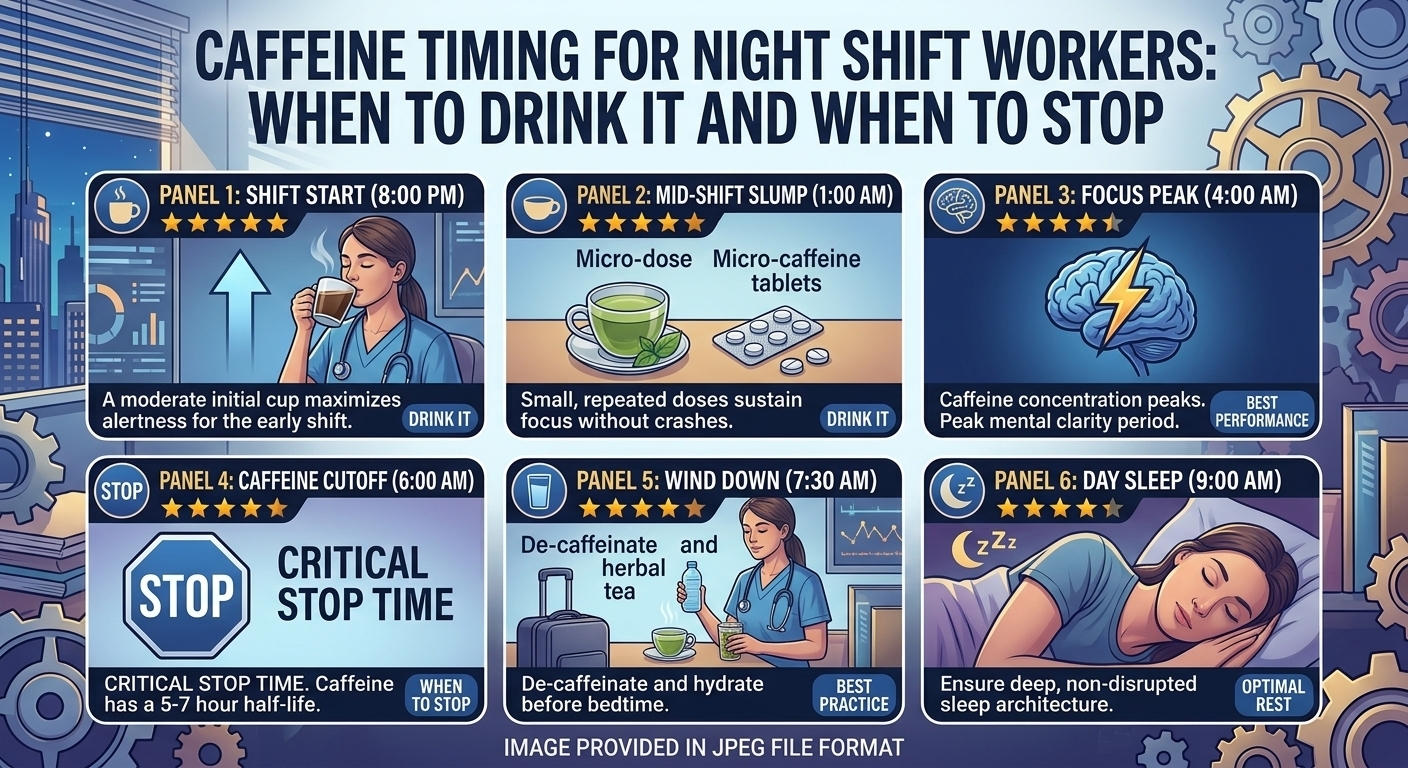
Most night workers make the mistake of sipping coffee continuously throughout the night just to keep their eyes open. A better approach is to front-load your caffeine intake. This gives you the boost you need when your body naturally wants to sleep, while giving your system time to clear the stimulant before your shift ends.
Imagine you work a standard shift from 11 PM to 7 AM, and you plan to sleep from 8 AM to 3 PM.
Your ideal caffeine window happens mostly in the first half of the night. You might have your first cup around the start of your shift to help wake up. You can use a second dose around 2 AM or 3 AM to push through the major circadian low point—that brutal wall of fatigue that hits most overnight workers in the middle of the night.
After that mid-shift point, you want to taper off. The exact schedule depends on when your shift starts, when you need to sleep, and how sensitive you are to stimulants. If you know you take a long time to clear caffeine, you should move your final cup even earlier.
Managing the Transition Back: Caffeine Strategies for Off-Days and Rotating Schedules
Shift rotations and days off introduce a completely different set of challenges that can throw your entire system out of whack. When you finally get a couple of days away from the night shift, the natural temptation is to sleep until noon and drink coffee at all hours to catch up on social life or chores. Doing this creates a brutal cycle known as social jetlag. Your body gets confused about when it is supposed to rest, making the transition back to your first night shift feel twice as heavy.
To manage your days off without wrecking your biological rhythm, you need a gentler approach to caffeine. On your first day off, try to limit your sleep-in to an extra hour or two rather than sleeping the entire day away. If you rely on coffee, keep your normal morning dose to help anchor your waking time, but cut off all caffeine consumption by early afternoon just like you would on a work day. This prevents you from pushing your internal clock even further out of alignment.
When it is time to transition back to the night shift, strategic caffeine use becomes your best tool for shifting your internal clock forward. Instead of dragging yourself through your first night shift in a fog, use a moderate dose of caffeine right at the start of that shift to force alertness. Pairing this initial boost with bright light exposure helps signal to your brain that your schedule has flipped back to overnight mode.
Navigating Caffeine Tolerance and Resetting Your System
If you have been working overnights for a while, you probably notice that your usual cup of coffee doesn’t pack the same punch it used to. Over time, your brain gets used to your daily coffee habit and actually grows extra receptors to catch all that floating adenosine. That means your usual morning brew stops working like it used to, and you suddenly need more just to feel like your normal self. It’s super easy to end up in a frustrating loop—grabbing stronger energy drinks, doubling up on espresso shots, or sneaking in an extra cup late in the shift just to chase that original burst of energy.
Unfortunately, chasing that feeling with more caffeine only digs you deeper into a hole of poor sleep quality and daytime fatigue. When your total daily caffeine load stays high around the clock, your daytime sleep becomes lighter and much less restorative, even if you manage to stay in bed for eight hours. You wake up feeling hollow, which leads right back to needing more stimulants as soon as your next shift begins.
Breaking this cycle doesn’t mean you have to quit caffeine completely or suffer through agonizing withdrawal at work. A gradual tapering strategy works much better for shift workers. Try reducing your total daily intake by about a quarter every few days. This slow step-down allows your brain to gradually reset its receptor sensitivity without triggering the severe headaches and crushing fatigue that come from quitting cold turkey. Within a couple of weeks, you will likely find that a much smaller amount of caffeine gives you the alertness boost you actually need.
When to Stop—A Clear Caffeine Cutoff
If you want to protect your daytime sleep, you need a firm stopping point. Sleep hygiene experts at the Sleep Foundation generally recommend avoiding caffeine for at least six hours before your planned bedtime.
For a night worker sleeping at 8 AM, that means your absolute final drop of caffeine should happen no later than 2 AM.
This rule changes based on your personal sleep schedule. If you get off work at 7 AM but run errands and don’t plan to sleep until 10 AM, your math shifts. However, for most people who head straight home to sleep, a 2 AM or 3 AM cutoff is a safe and practical boundary.
Stopping at 2 AM might feel impossible during your first few attempts. You will hit that 4 AM slump and desperately want a cup of coffee. But drawing a hard line changes the quality of your daytime rest. When you stop early, your body gets a real chance to wind down, making it much easier to fall asleep when your head finally hits the pillow.
What to Use Instead During the Last Few Hours
Reaching your caffeine cutoff means you still have hours of work left without your favorite crutch. You hit your cutoff. No more coffee, no more energy drinks. But your shift isn’t over, and your eyelids still feel like sandpaper. This is where things get real. You have to wake your brain up using physical things instead of a mug.
Start with movement. And no, nobody is asking you to run laps around the warehouse. Just get up and walk with some purpose. Walk down the hallway, take the long way to the bathroom, or march up a flight of stairs. You want to get your heart rate up just a tiny bit and push some warm blood through your limbs. It feels annoying when you are exhausted, but five minutes of actual movement gives your brain a stubborn little jolt that buys you twenty minutes of clear head space.
Second, pay attention to hydration and food. Mild dehydration makes fatigue feel much worse. Sipping on cold water throughout the second half of your shift keeps you sharp. Eating a light, protein-rich snack can also steady your energy levels without causing a heavy sugar crash.
Third, use light if your workplace allows it. Bright overhead lighting or stepping outside into morning light as your shift ends tells your brain that it is time to be alert, helping you push through the final hour safely.
[How to Stay Awake During a Night Shift Naturally]
[What to Eat Before, During, and After a Night Shift]
Writer’s Take
If I had to give a night worker one absolute caffeine rule, it would be this: treat your last sip of caffeine like a hard deadline, just like clocking out.
Mark 3 AM on your mental calendar as your point of no return. Front-load your coffee to the beginning of your shift when you actually need help waking up, and let your body slowly process the stimulant before you walk out the door.
If you still feel groggy after your cutoff, lean on cold water, a quick walk, or a light snack instead of reaching for another mug. Protecting your daytime sleep isn’t about suffering through your shift. It is about timing your energy so you can actually get the rest you need to stay healthy over the long haul.
[How to Sleep During the Day After a Night Shift]
FAQ
Does caffeine tolerance change on the night shift?
Yes, your body builds up a tolerance to caffeine within a week or two of regular daily use. This means you need more and more caffeine to get the same alertness boost, which only makes your sleep problems worse over time.
Is caffeine after midnight always bad?
Not necessarily, but it depends entirely on when you plan to go to sleep. If you work past midnight and don’t plan to sleep until late afternoon, a cup of coffee after midnight might fit safely inside your personal window.
What about energy drinks vs. coffee?
Energy drinks often pack double or triple the caffeine of a regular mug of coffee, plus hidden extras like guarana that keep your nervous system wired for hours longer. Down one of these late in your shift, and your body stays stuck in high gear long after your head hits the daytime pillow, wrecking the deep sleep you desperately need.
Does napping cancel out caffeine’s effect?
A short nap does not magically clear caffeine out of your bloodstream. But if you time it right, you can trick the system. Downing a cup of coffee and immediately dropping into a twenty-minute power nap creates a neat little shortcut. By the time your alarm rings, the caffeine has cleared your gut, entered your brain, and started blocking those tired-out receptors right as you wake up.
Sources
- Journal of Caffeine Research: Pharmacokinetics of caffeine and its clearance rates in healthy adults.
- Sleep Foundation: Guidelines on caffeine half-life and its impact on slow-wave and REM sleep architecture.
- National Institutes of Health (NIH): General data on stimulant metabolism and adenosine receptor blocking mechanisms.

Daniel Carter is the founder of NightShiftWell. He spent over a decade working night and rotating shifts in logistics and warehouse operations before starting this site to share what actually works — and what doesn’t — for staying healthy on an inverted schedule.